
Unlock Better Performance: Water Softener Resin Explained—How It Works & When to Replace It
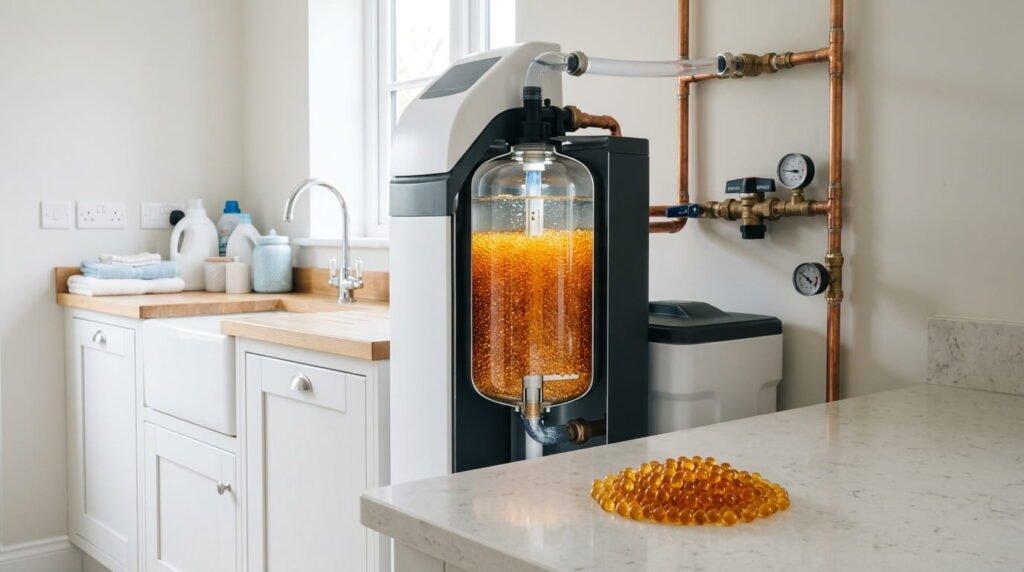
Water softener resin may look like nothing more than a tank filled with tiny beads, but these beads are responsible for one of the most important jobs inside a conventional ion-exchange water softener.
When hard water enters your home, it carries dissolved minerals—particularly calcium and magnesium. As this water flows through a resin bed, the resin exchanges these hardness ions for sodium ions. The result is softened water with a lower concentration of the minerals that contribute to limescale.
But what happens when the resin becomes less effective? How long should water softener resin last? Can poor performance always be blamed on old resin? And, most importantly, when should you actually replace it?
This complete guide explains how water softener resin works, what affects its performance, how to identify potential problems, when replacement may make sense, and what to consider before choosing replacement resin.
Quick answer: Water softener resin is an ion-exchange material made from small beads. In a conventional sodium-based softener, the beads exchange calcium and magnesium ions for sodium ions. Resin is regenerated with brine so it can continue working. If your softener starts producing harder water, don’t automatically replace the resin—check salt supply, regeneration settings, water flow, fouling, and other components first. Resin replacement is generally considered when the resin has genuinely deteriorated or lost significant capacity and other causes have been ruled out.
Key Takeaways
- Water softener resin is the core working material in a conventional ion-exchange softener.
- Resin beads exchange calcium and magnesium for sodium ions in sodium-based systems.
- The resin needs regular regeneration to restore its ion-exchange capacity.
- The effectiveness of resin is determined by the quality, amount, length of time it has been in use, the quality of the water used, as well as how the system operates.
- Poor softening does not automatically mean the resin needs replacing.
- Salt problems, incorrect settings, fouling, iron, chlorine exposure, and mechanical issues can also affect performance.
- Existing limescale is not automatically removed simply because new water is softened.
- Replacement resin should be compatible with the softener, water conditions, and intended application.
- UK households need to consider appropriate arrangements for drinking and cooking water when using conventional sodium-based softeners.
- Proper maintenance can help you get better performance and longer service life from your softener.
Table of Contents
- What Is Water Softener Resin?
- How Does Water Softener Resin Work?
- Water Softener Resin vs Filter Media
- Why Does Resin Need Regeneration?
- What Affects Water Softener Resin Performance?
- How Long Does Water Softener Resin Last?
- Signs Your Water Softener Resin May Be Failing
- Poor Softening? Check These Things First
- When Should You Replace Water Softener Resin?
- How to Choose Replacement Water Softener Resin
- Can You Replace Water Softener Resin Yourself?
- How to Maintain Water Softener Resin
- Water Softener Resin and UK Drinking Water
- Common Water Softener Resin Mistakes
- Myths vs Facts
- Frequently Asked Questions
- Final Verdict
1. What Is Water Softener Resin?
Water softener resin is a specialised ion-exchange material used to reduce the calcium and magnesium responsible for water hardness.
In a conventional domestic softener, the resin is stored inside a resin tank, also called a mineral tank.
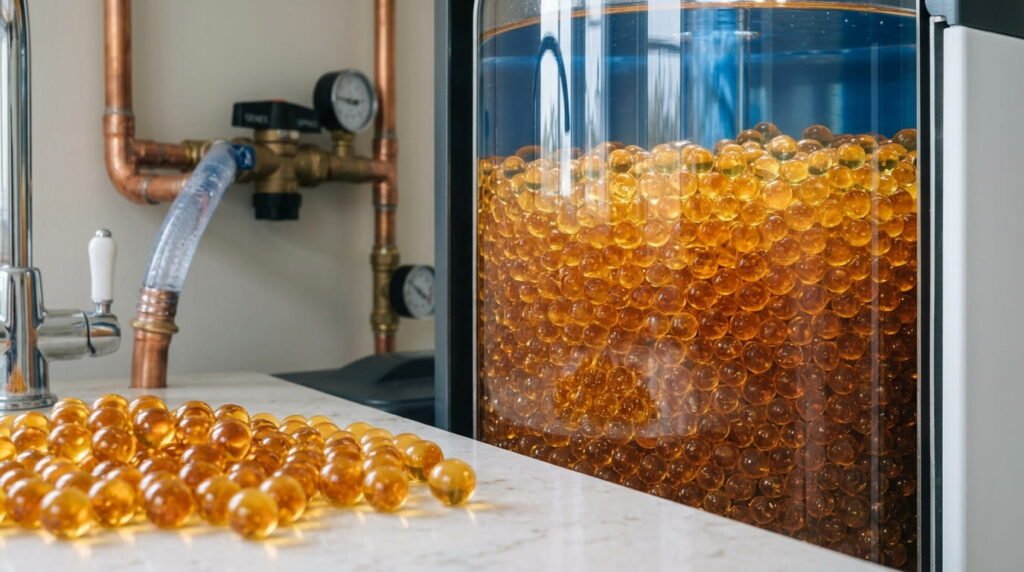
Inside the tank, there are thousands of very tiny resin beads. The resin beads have a site on each bead that attracts positively charged ions. When the hard water flows over the resin bed, the calcium and magnesium in the hard water will attach themselves to the resin; however, the sodium ions will be released into the treated water.
In simple terms:
Hard water → Resin bed → Calcium & magnesium exchanged → Softened water
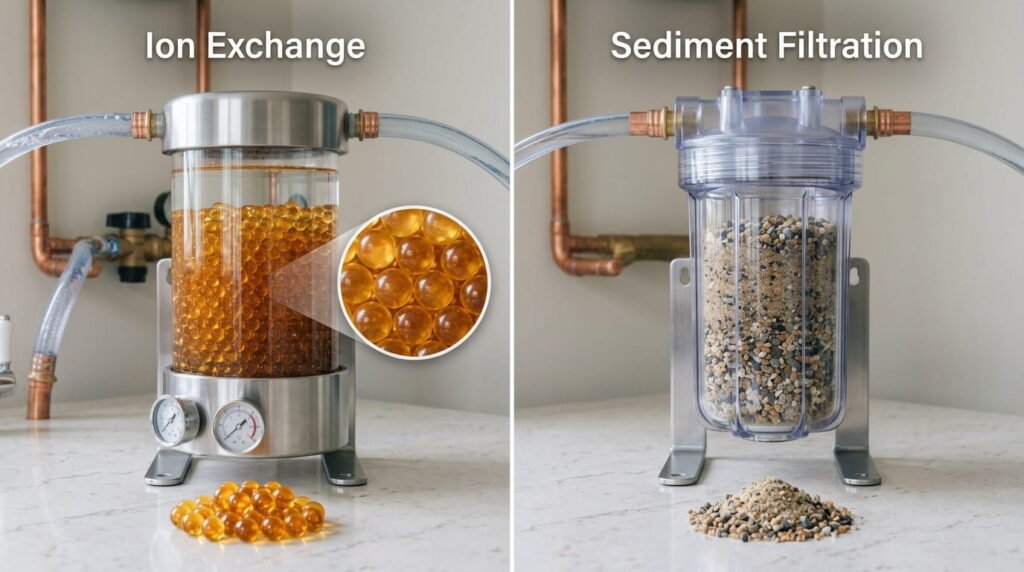
This is what makes resin fundamentally different from ordinary filter media.
A conventional sediment filter, for example, may physically capture particles. Ion-exchange resin works differently because it interacts with dissolved ions.
That distinction is important when you’re researching water-treatment products.
A product may be marketed as a filter, conditioner, or limescale treatment, but that doesn’t necessarily mean it actually reduces water hardness.
2. How Does Water Softener Resin Work?
The science behind ion exchange can sound complicated, but the basic idea is surprisingly simple.
Imagine the resin beads as having thousands of tiny exchange sites.
When the resin is ready for use, these sites are predominantly occupied by sodium ions in a conventional sodium-cycle softener.
Hard water then enters the resin tank.
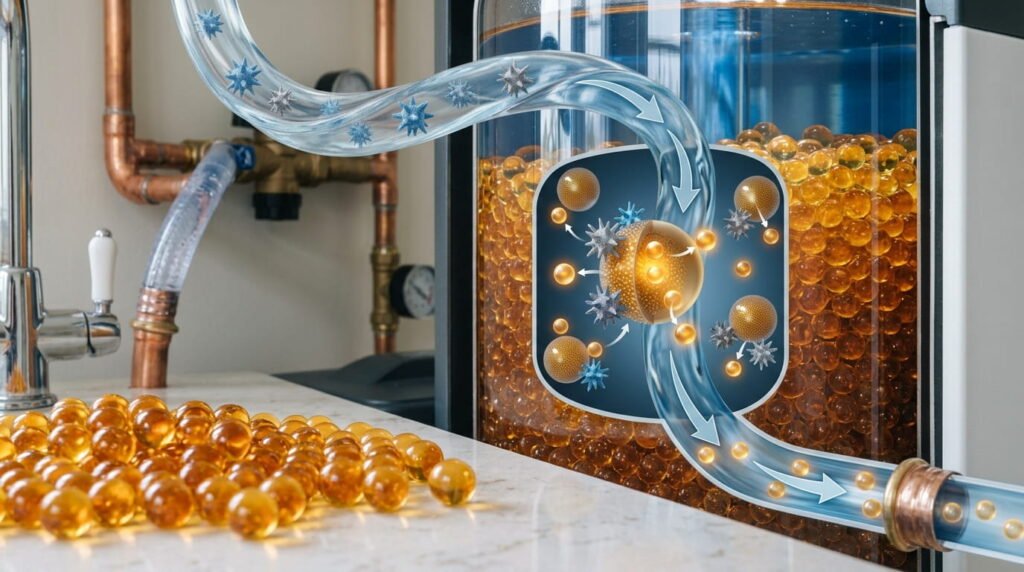
It contains dissolved calcium and magnesium ions. These ions have a stronger attraction to the resin than sodium does.
As the water passes through:
- Calcium moves from the water onto the resin.
- Magnesium moves from the water onto the resin.
- Sodium moves from the resin into the water.
- The water leaves the resin tank with reduced hardness.
The resin isn’t “destroying” calcium or magnesium.
Instead, it is exchanging ions.
This is why the process is called ion exchange.
Why calcium and magnesium matter
Calcium and magnesium are the principal minerals responsible for water hardness.
When hard water is heated or evaporates, these minerals can contribute to scale deposits.
That can lead to familiar problems such as:
- Limescale around taps
- Deposits on showerheads
- Scale inside kettles
- Mineral buildup around sinks
- Deposits in hot-water equipment
- More noticeable soap residue
Reducing the hardness minerals can therefore help control one of the major causes of limescale.
3. Water Softener Resin vs Filter Media
One of the easiest mistakes to make is assuming that all water-treatment media work in the same way.
They don’t.
Filter media
Depending on its design, filter media may:
- Capture sediment
- Reduce particles
- Adsorb some material
- Improve flavor and aroma
- Target specific contaminants
Ion-exchange resin
Water softener resin is designed specifically for ion exchange.
It exchanges selected dissolved ions rather than simply trapping particles.
That means a resin bed can reduce hardness without behaving like a conventional sediment filter.
Why this matters when buying a system
If your main problem is hard water and limescale, don’t simply search for a product described as a “water filter.”
I want you to see what the treatment technology is like.
Ask:
Does this product truly lower calcium and magnesium levels, or is it merely claiming to control limescale?
A single query will help prevent you from purchasing a product that is not aligned with your objectives.
4. Why Does Resin Need Regeneration?
Resin doesn’t have an unlimited capacity.
As hard water passes through the resin bed, calcium and magnesium gradually occupy more of the resin’s exchange sites.
Eventually, the resin becomes loaded with hardness ions.
At that point, its ability to soften additional water decreases.
This is where regeneration comes in.
A conventional softener uses a concentrated salt solution, known as brine, to restore the resin.
During regeneration, sodium ions from the brine displace the accumulated calcium and magnesium from the resin.
The displaced minerals are then flushed away during the regeneration cycle.
After regeneration, the resin is ready to soften water again.
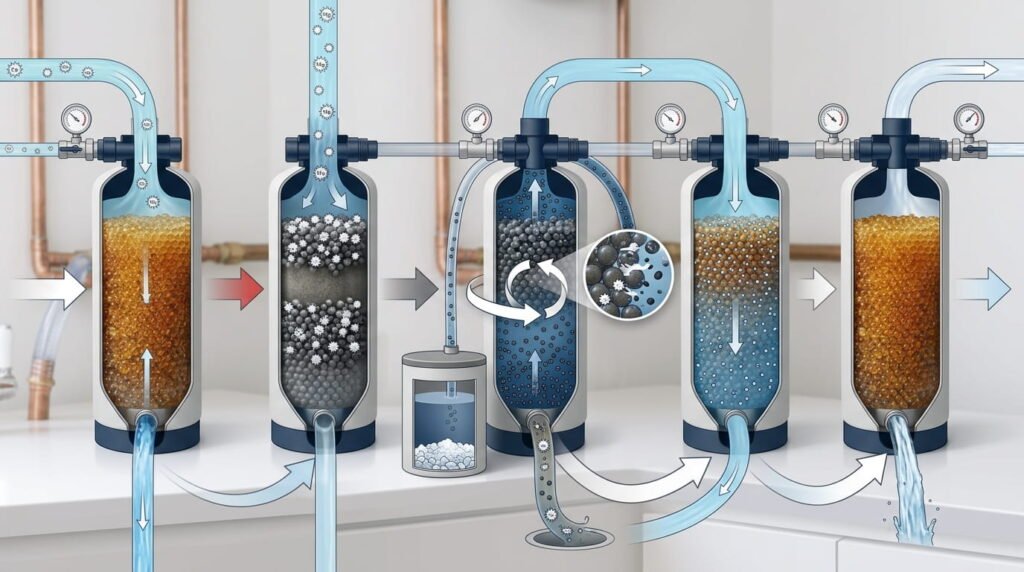
The basic cycle
A conventional softener can therefore be thought of as having several stages:
1:Service
Hard water flows over the resin.
2:Resin exhaustion
The resin is becoming increasingly saturated with calcium and magnesium.
3:Regeneration
The resin’s sodium form is restored by brine.
4:Rinse
The system flushes out the displaced minerals and remaining brine.
5. Return to service
The resin is ready for another softening cycle.
This repeated process is why a water softener can continue working for years without replacing the resin every time its capacity is used.
5. What Affects Water Softener Resin Performance?
Resin doesn’t work in isolation.
Several factors can influence how effectively and how long it performs.
Water hardness
The harder your incoming water is, the more calcium and magnesium the resin has to exchange.
A household with very hard water can therefore place a greater demand on its resin than a household with moderately hard water.
Water usage
A larger household typically uses more water.
Higher water consumption means more water passes through the resin bed, increasing the frequency at which regeneration may be required.
Resin quantity
The amount of resin inside the tank affects the softening capacity of the system.
A larger resin bed generally has more exchange capacity than a smaller one, assuming other operating conditions are appropriate.
Regeneration settings
The performance of a system is influenced by several different things.
If the system isn’t regenerating at an appropriate frequency or using the correct regeneration conditions, the resin may not be restored effectively.
Salt supply
A salt-based softener needs an appropriate supply of suitable regeneration salt.
If the salt runs out—or if a problem prevents brine from being produced or delivered correctly—the resin may not regenerate properly.
Iron and other substances
Certain water conditions can contribute to resin fouling.
For instance, the presence of iron in water may reduce resin effectiveness and could potentially necessitate some form of water treatment based on the quality of the water source.
Chlorine exposure
Long-term exposure to chlorine can contribute to deterioration of some ion-exchange resins.
The impact depends on the specific resin, concentration, and operating conditions.
Physical condition of the system
A resin bed can be perfectly usable while another part of the softener has developed a problem.
The control valve, injector, brine system, seals, and other components all play important roles.
That’s why troubleshooting should come before automatically ordering replacement resin.
6. How Long Does Water Softener Resin Last?
One of the most common questions homeowners ask is:
“How long does water softener resin last?”
There isn’t one guaranteed lifespan that applies to every system.
There are a number of factors that will affect how long your resin lasts, including:
- Resin quality
- Water chemistry
- Chlorine exposure
- Iron or other contaminants
- Water consumption
- Regeneration conditions
- Maintenance
- Operating temperature
- System design
A well-maintained softener can potentially keep its original resin for many years, but eventually the resin can lose capacity or become damaged.
The important point is this:
Don’t replace resin simply because a certain number of years have passed.
Instead, consider the system’s actual performance.
If your softener is producing hard water, investigate the cause.
The resin may be responsible—but it may also be something much simpler.
7. Signs Your Water Softener Resin May Be Failing
Resin deterioration isn’t always obvious.
You might notice that your water doesn’t seem as soft as it used to.
Here are several warning signs worth investigating.
Hard water is returning.
One of the biggest clues is that hardness begins appearing in the treated water.
You may notice:
- More limescale
- Soap behaving differently
- Scale returning around taps
- Kettle deposits becoming noticeable again
However, hard water returning doesn’t automatically prove that the resin is exhausted.
Other system problems can create the same symptom.
The softener regenerates normally, but performance remains poor.
If the system appears to complete its regeneration cycle but treated water still has significant hardness, resin condition may deserve investigation.
Resin capacity appears to have declined.
If the softener requires regeneration much more frequently despite unchanged household water use and settings, something may be affecting its capacity.
Resin has been exposed to damaging conditions.
If the system has experienced prolonged chlorine exposure, fouling, contamination, or other adverse conditions, the resin may deteriorate faster than expected.
Resin beads are physically damaged.
Resin beads can deteriorate or break down over time.
If significant physical breakdown has occurred, replacement may be necessary.
8. Poor Softening? Check These Things First
This is perhaps the most important troubleshooting section of the entire guide.
Don’t assume that poor softening means you need new resin.
Before replacing the resin, check the following.
- Is there enough salt?
If the salt supply is empty or inadequate, the resin may not regenerate properly. - Is the system regenerating?
Check whether the softener is actually running its regeneration cycle. - Are the settings correct?
Incorrect hardness settings or regeneration settings can affect performance. - Is the brine system working?
A problem with brine production, suction, or delivery can prevent proper regeneration. - Are there salt bridges?
The hard layer of salt known as a “salt bridge” will stop water from getting to the salt beneath it. This can make the system appear to contain plenty of salt when the regeneration process isn’t actually receiving what it needs. - Is the bypass valve in the correct position?
If the system is bypassed, untreated hard water can go straight into the plumbing of the home. - Has the water supply changed?
Changes in incoming hardness or water quality can affect softener performance. - Might the resin have been contaminated?
Resin’s ability to perform can be hindered by iron or other materials. - Is the control valve functioning correctly?
A mechanical or electronic problem can disrupt service or regeneration even when the resin itself is fine. - Is the resin genuinely old or damaged?
Only after other possibilities have been considered should resin replacement become the leading suspect.
This approach can save money and prevent unnecessary work.
9. When Should You Replace Water Softener Resin?
Resin replacement may make sense when the resin has genuinely lost significant performance and other possible causes have been eliminated.
Potential reasons include:
- The deterioration of resins.
- Significant physical breakdown
- Persistent loss of softening capacity
- Severe fouling
- Long-term exposure to unsuitable water conditions
- Resin contamination
- A system that has reached the practical end of its resin’s service life
However, there isn’t a single “how long should I wait before replacing my tires” rule.
A better approach is to evaluate:
Performance + resin condition + system age + water chemistry + maintenance history
If your softener is old and consistently fails to achieve the expected reduction in hardness despite correct settings and proper regeneration, replacement resin may be worth considering.
10. How to Choose Replacement Water Softener Resin
Finding replacement resin isn’t simply about buying the cheapest bag available.
The resin needs to be suitable for your application.
Check the resin type.
Different ion-exchange resins can have different properties and intended uses.
Make sure the replacement material is appropriate for domestic water softening.
Check compatibility
The resin should be compatible with your:
- Resin tank
- Softener design
- Operating conditions
- Regeneration process
- Water application
Consider water quality
Your incoming water may contain characteristics that affect resin performance.
If your water has significant iron or other unusual characteristics, don’t select replacement resin without considering those conditions.
Consider drinking-water use
If the softener provides water for household use, make sure the resin is NSF-certified for any desired potable-water application.
Check manufacturer recommendations
When you purchase a water softener, your softener manufacturer may provide specifications for the types of resins that are compatible with their softeners as well as the procedure to follow when replacing the resin in the softener.
This is one of the most useful places to start.
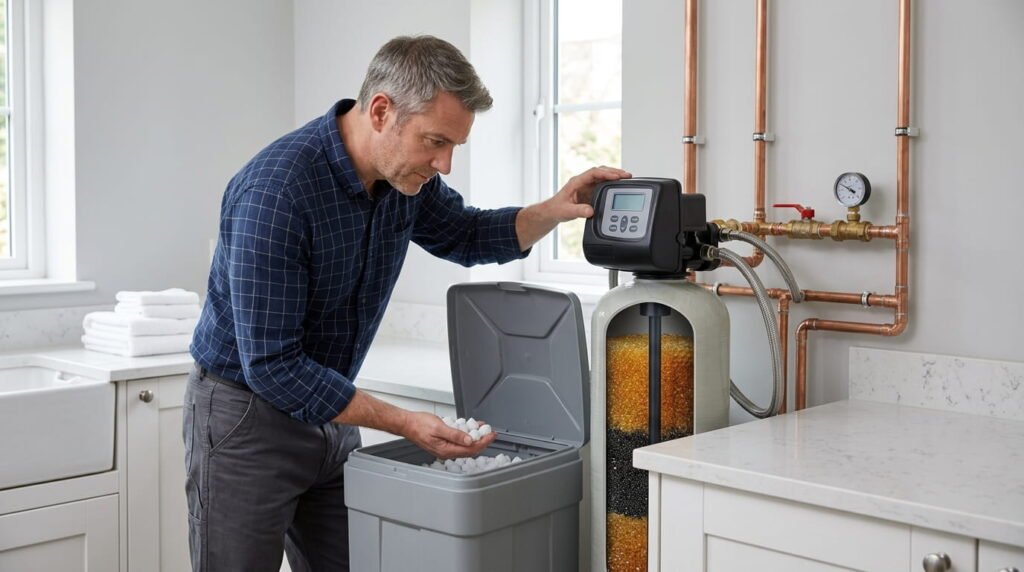
11. Can You Replace Water Softener Resin Yourself?
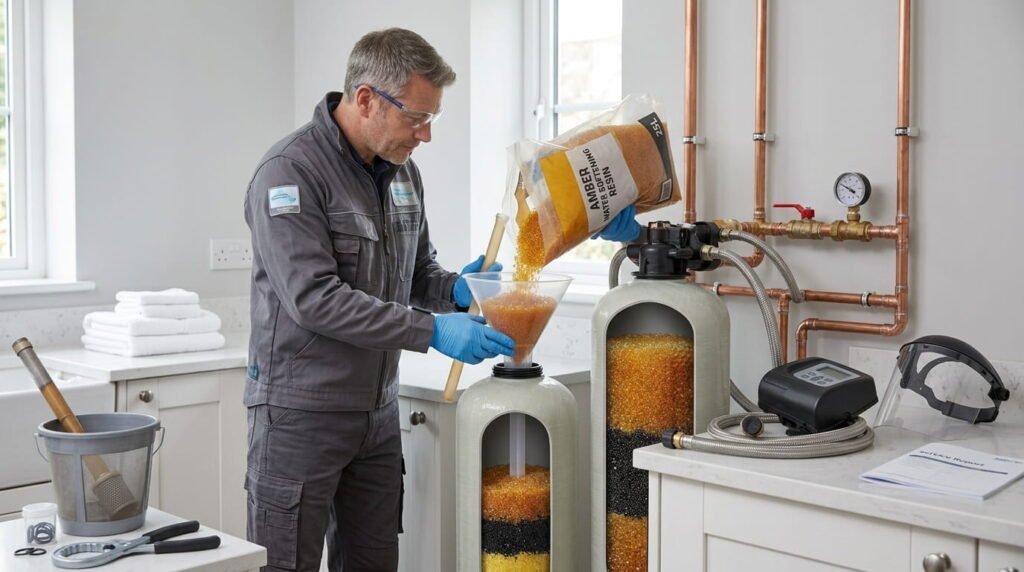
Technically, resin replacement involves removing the old resin and introducing new resin into the mineral tank.
On the other hand, this does not have to be an easy project that you can do on your own.
Depending on the softener design, replacement can involve:
- Isolating the water supply
- Disconnecting components
- Removing the control valve
- The process of getting to the resin tank.
- Removing old resin
- Checking internal components
- Loading new resin
- Reassembling the system
- Flushing and commissioning the softener
Some tanks are large and heavy, and incorrect handling can damage internal components.
There is also the question of hygiene and potable-water installation.
For these reasons, following the manufacturer’s instructions is essential. If you’re uncertain about the procedure or the system supplies drinking water, using an appropriately qualified professional can be the safer and more reliable choice.
12. How to Maintain Water Softener Resin
You can’t eliminate every factor that affects resin life, but good maintenance can help the system perform reliably.
Keep the salt supply maintained.
Don’t allow the softener to run without the salt it needs for regeneration.
Monitor performance
Pay close attention to changes made in:
- Limescale
- Water hardness
- Regeneration frequency
- Salt consumption
- Water quality
A noticeable change can be an early warning that something needs attention.
Keep the system clean.
Follow the manufacturer’s cleaning and sanitisation recommendations.
Check settings
Make sure the hardness and regeneration settings remain appropriate for your household and water supply.
Don’t ignore unusual symptoms.
If the softener suddenly starts behaving differently, investigate early rather than allowing a small problem to become a costly one.
Follow the manufacturer’s maintenance schedule.
Different softeners have different designs.
The manufacturer’s instructions should therefore take priority over generic advice.
13. Water Softener Resin and UK Drinking Water
UK homeowners need to pay particular attention to drinking-water arrangements when using conventional sodium-based ion-exchange softeners.
During the softening process, calcium and magnesium are exchanged for sodium.
This means the sodium concentration of treated water can be higher than that of the incoming water.
The UK’s Drinking Water Inspectorate advises maintaining an unsoftened drinking-water supply at the kitchen tap used for drinking and cooking when a domestic ion-exchange softener is installed.
This is an important consideration when planning a whole-house system.
What about baby formula?
This is another area where extra care is important.
DWI guidance advises that artificially softened water should not be used to make up infant feeds.
If you’re installing a softener, make sure you understand which outlets will provide softened water and which should remain connected to the unsoftened supply.
For UK households, this isn’t simply a technical detail—it should be part of the installation plan from the beginning.
14. Common Errors When Working With Water Softeners’ Resin
Mistake 1: Replace resin too early.
Even though poor softening does not necessarily indicate that the resin has been used up.
Mistake 2: Buying incompatible resin
A cheap replacement isn’t necessarily a good replacement.
Compatibility matters.
Mistake 3: Ignoring water chemistry
Iron, chlorine, and other characteristics of the incoming water can affect resin performance.
Mistake 4: Not Regenerating
High-quality resins must have a regular regeneration schedule to function properly over long periods of time.
Mistake 5: Confusing resin with a filter
Resin works through ion exchange; conventional filter media may perform completely different functions.
Mistake 6: Ignoring the control valve
A softener is more than a tank of resin.
If the control valve or brine system isn’t functioning properly, replacing the resin may not solve the problem.
Mistake 7: Forgetting drinking-water arrangements
When you use a standard sodium-based water softener, you need to think about what source provides you with your drinking and cooking water.
15. Myths vs Facts About Water Softener Resin
Myth: Resin permanently removes calcium and magnesium.
Fact: Resin exchanges these hardness ions onto the resin. Regeneration then restores the resin so the process can continue.
Myth: If a softener produces hard water, the resin must be dead.
Fact: Salt problems, regeneration settings, bypass valves, brine-system problems, and other faults can also cause poor softening.
Myth: All water-treatment resin is the same.
Fact: Resin products can differ in properties, quality, and intended application.
Myth: A water filter and softener resin do the same job.
Fact: There are differences among resin products with regard to physical properties, product quality, and how they should be used.
Myth: Resin must be replaced at regular intervals.
Fact: The chemical makeup of your water supply, as well as how much it is operated on, the amount of maintenance done to it, and how often it is used, will determine how long a resin will last.
Myth: New resin will remove existing limescale.
Fact: New resin treats incoming water. Existing deposits generally need to be cleaned or descaled separately.
16. Frequently Asked Questions
What is water softener resin?
Water softener resin is an ion-exchange material, usually supplied as small beads, that reduces calcium and magnesium from hard water in a conventional water softener.
How does water softener resin work?
Hard water will lose some of its “hardness” when passing over a resin bed. The resin bed exchanges the calcium and magnesium ions in the hard water for sodium ions.
What is water softener resin made of?
Most conventional domestic softeners use synthetic ion-exchange resin in bead form. The exact material and specifications vary between products.
How often does water softener resin need to be replaced?
No single, standard replacement schedule exists for resin. The lifespan of a resin will vary based upon the quality of the water being filtered; the conditions under which it operates; how often it is used; how well maintained it is; and the type of resin that is purchased.
How do I know if my resin needs replacing?
A lack of softening capability even though the system is working properly (i.e., has enough salt, is correctly configured, has undergone regeneration, etc.) could be an indication that the resin in the unit is deteriorating. Before anything else is done, test and troubleshoot.
Can water softener resin wear out?
Yes. Over time, resin can lose capacity or experience physical or chemical deterioration. The rate depends on operating conditions.
Does resin remove calcium from water?
In a conventional ion-exchange softener, calcium is exchanged onto the resin while sodium is released into the treated water.
Does resin remove magnesium?
Yes. Magnesium is also one of the primary hardness ions targeted by conventional ion-exchange resin.
Does water softener resin need salt?
The resin itself doesn’t “consume” salt as part of the service process. However, conventional sodium-cycle softeners use a salt-derived brine solution during regeneration to restore the resin’s sodium form.
Can I clean water softener resin?
Some systems may have specific cleaning or resin-treatment procedures, particularly where fouling is an issue. Always follow the manufacturer’s instructions and use only products appropriate for the specific system.
Can iron damage water softener resin?
Iron can foul resin and interfere with its performance. The seriousness depends on the type and concentration of iron and the operating conditions.
Does chlorine affect water softener resin?
Long-term exposure to chlorine can contribute to degradation of some resin materials. The effect depends on the resin and exposure conditions.
Is replacement resin expensive?
The cost varies considerably depending on resin type, quantity, supplier, and whether professional labour is required. Compare the complete replacement cost rather than looking only at the price per litre or bag.
Can I replace water softener resin myself?
Some homeowners may be able to replace resin in certain systems, but the process can involve heavy tanks, internal components, and potable-water considerations. Manufacturer instructions should be followed carefully, and professional help may be appropriate.
Does new resin make my water completely mineral-free?
No. Conventional softening primarily reduces hardness ions such as calcium and magnesium. A water softener is not the same as a reverse-osmosis or demineralisation system.
Does water softener resin make water safe to drink?
Water softener resin is designed to reduce hardness; it should not automatically be considered a complete drinking-water purification system. UK households should also consider the sodium increase associated with conventional softening and maintain the appropriate unsoftened drinking-water supply.
17. Final Verdict: Is Water Softener Resin Really That Important?
Absolutely.
Although resin beads are hidden inside the tank, they perform the critical ion-exchange process that allows a conventional water softener to reduce calcium and magnesium.
Understanding the resin can help you make better decisions about everything from routine maintenance to troubleshooting and replacement.
But there’s an important lesson to remember:
Don’t replace resin simply because your water softener isn’t performing as expected.
Start with the basics.
Check the salt supply. Check regeneration. Check the settings. Check the bypass valve. Consider the water quality. Inspect the brine system and control valve. If those areas are working correctly and the softener still cannot deliver the expected reduction in hardness, then the resin itself may deserve closer attention.
When replacement is genuinely necessary, choose a compatible, high-quality resin designed for your application, and follow the manufacturer’s installation and maintenance guidance.
For UK homeowners, don’t overlook the drinking-water side either. Conventional sodium-based softeners change the mineral composition of treated water, so appropriate unsoftened drinking and cooking water arrangements should be part of the installation plan.
The Bottom Line
Water softener resin is the heart of an ordinary ion exchange softener. The tiny beads of resin do the actual work of replacing calcium and magnesium, while the regeneration step allows the resin to be used again for another cycle.
Look after the system, understand the warning signs, troubleshoot before replacing components, and choose replacement resin carefully when the time eventually comes.
That approach can help you unlock better performance, avoid unnecessary replacement costs, and get more value from your water-softening system.