The Shocking Difference You Need to Know! Water Softener vs Water Filter
Affiliate disclosure: This article contains affiliate links. AquaClariX may earn a commission on qualifying purchases at no extra cost to you. Product information comes from supplied Amazon listings and manufacturer details. We do not test these products ourselves.
The Short Answer
A water softener removes hardness minerals (calcium and magnesium) to stop limescale. A water filter removes contaminants that affect taste, smell and safety. Neither does the other’s job. If limescale is wrecking your kettle, boiler and shower screen, you need a softener. If your tap water tastes of chlorine or you want to cut a specific contaminant, you need a filter. Many homes benefit from both.
Table of Contents
Quick Comparison: Water Softener vs Water Filter
| Feature | Water Softener | Water Filter |
|---|---|---|
| Main purpose | Removes water hardness | Removes unwanted substances from water |
| Targets | Calcium and magnesium | Depends on the filter media used |
| Technology | Ion exchange resin | Activated carbon, sediment, reverse osmosis, ion exchange cartridges |
| Limescale control | Prevents new limescale forming | Depends on the filter; most carbon filters do nothing |
| Chlorine reduction | Not its job | Activated carbon can reduce it |
| Installation | Whole house, plumbed into the supply | Jug, tap, under-sink or whole house |
| Upkeep | Add salt, occasional servicing | Replace cartridges or membranes |
| Best for | Hard water areas | Taste, odour, sediment and specific contaminants |
What Is a Water Softener?
A water softener is a device that reduces the dissolved calcium and magnesium that make water “hard”. When hard water is heated, those minerals form limescale inside boilers, kettles, washing machines, taps and shower heads.
Most domestic softeners use ion exchange:
- Hard water flows through a tank of resin beads.
- Calcium and magnesium ions stick to the beads.
- Sodium or potassium ions are released into the water in their place.
- Water leaves the softener with very little hardness.
- When the beads are full, a salt brine flushes them clean (regeneration) and the cycle starts again.
How often regeneration happens depends on your water hardness and how much water your household uses.
Benefits of a Water Softener
- Less limescale in pipes, taps and appliances
- Better efficiency from appliances with heating elements
- Better lather from soap and detergent
- Less soap scum and fewer hard water deposits
Important: a softener prevents new scale. It does not remove limescale that has already built up. That still needs descaling.
What Is a Water Filter?
A water filter removes specific contaminants using a particular medium or process. What it removes depends entirely on how it is built, so results vary widely between products.
Common Filtration Technologies
- Activated carbon: Reduces chlorine taste and odour and some other substances, depending on design.
- Sediment filters: Catch sand, rust and other coarse particles. Often the first stage in a multi-stage system.
- Reverse osmosis (RO): A membrane removes many dissolved ions and substances. RO systems can use extra water and reduce water pressure, and often need pre- and post-filter stages.
- Ion exchange cartridges: Found in some filter jugs to reduce temporary hardness and kettle scale. They are not a substitute for a whole-house softener.
Be wary of vague claims like “removes impurities” or “purifies water”. Always check the performance data sheet to see exactly which contaminants are covered.
Water Softener vs Water Filter: 7 Key Differences
1. Purpose
A softener tackles hardness and limescale. A filter tackles taste, smell, sediment and chosen contaminants. Get a softener for limescale. Get a filter for drinking water quality.
2. How They Work
Softeners swap hardness ions for sodium or potassium and are regenerated with salt brine. Filters trap or adsorb contaminants (carbon, sediment) or push water through a membrane (RO). A carbon filter cannot soften water, and a softener cannot filter it.
3. What They Remove
| Water concern | Water softener | Water filter |
|---|---|---|
| Calcium and magnesium hardness | Reduced | Depends on type |
| Chlorine taste and odour | Not reduced | Activated carbon can reduce |
| Sediment | Not reduced | Sediment filters capture it |
| Lead | Not reduced | Some certified models reduce it |
| Dissolved substances | Not reduced | RO can reduce many |
4. Effect on Limescale
If limescale is your problem, a softener helps and a standard filter will not. Some ion-exchange jug cartridges reduce scale in your kettle, but they will not protect the rest of your plumbing. For whole-house scale control, the system must be properly designed and installed.
5. Impact on Drinking Water
Conventional softening replaces calcium and magnesium with sodium, which raises the sodium level in your water. The Drinking Water Inspectorate recommends keeping an unsoftened supply for drinking and cooking (usually the kitchen cold tap) and not using softened water to make infant formula. People on a low-sodium diet should seek medical advice.
6. Installation and Maintenance
Softeners need a suitable location, a drain for regeneration wastewater and easy access to top up salt. Upkeep includes adding the right type of salt, cleaning the brine tank and occasional servicing.
Filters range from a jug you fill by hand to under-sink and whole-house units. Follow the manufacturer’s schedule for cartridge replacement and check housings for leaks.
7. Cost and Running Expenses
| Cost factor | Water softener | Water filter |
|---|---|---|
| Upfront | Whole-house systems can cost hundreds of pounds | A jug is cheap; under-sink and RO systems cost more |
| Installation | Plumbing skills usually needed | Jugs need none; plumbed units may need a plumber |
| Consumables | Salt | Cartridges or membranes |
| Other running costs | Water used in regeneration, servicing | Replacement frequency and cartridge price |
Cheap units can cost more over time if consumables are pricey. Always compare total cost of ownership using the manufacturer’s maintenance details.
How to Test Your Water Hardness
White deposits on taps hint at hard water, but test to be sure.
- Ask your water supplier. UK suppliers publish hardness data by area or provide it on request.
- Use test strips. Quick, cheap and a good rough guide.
- Use a titration kit. Reagents are added drop by drop to measure hardness more precisely.
Understanding Water Hardness Levels
Hardness is measured as calcium carbonate (CaCO₃) in mg/L (ppm) or degrees of German hardness (°dH).
| Hardness (mg/L CaCO₃) | Classification |
|---|---|
| Up to 100 | Soft |
| 100–150 | Slightly hard |
| 150–200 | Moderately hard |
| 200–300 | Hard |
| 300 and above | Very hard |
Softened water typically contains between 0 and 70 mg/L CaCO₃.
Types of Water Softeners and Filters
Water Softener Types
- Ion exchange softeners: The most common type. Resin beads swap calcium and magnesium for sodium or potassium, regenerated with salt.
- Water conditioners (magnetic and electronic scale devices): These claim to reduce scale adhesion but do not remove hardness minerals, so they are not true softeners. Ask for evidence from a comparable domestic installation before buying.
Water Filter Types
| Filter type | Main purpose |
|---|---|
| Activated carbon | Reduces chlorine taste and odour, plus some other substances |
| Sediment | Captures suspended solids |
| Reverse osmosis | Reduces dissolved substances |
| Ion exchange cartridge | Reduces specific ions depending on resin type |
Not all filters of the same type perform equally. Check certified performance, not just the category.
Which Is Right for Your Home?
Choose a water softener if you want to reduce hardness throughout your home, protect appliances from scale and improve lather. Test your water hardness first.
Choose a water filter if you want to remove chlorine taste and odour, target a specific contaminant the filter is rated for, or prefer a countertop or under-sink system without whole-house treatment.
| Your main concern | Best starting point |
|---|---|
| Limescale on taps and shower screens | Water softener |
| Limescale inside appliances | Water softener |
| Chlorine taste and odour | Activated carbon filter |
| Particles and sediment | Sediment filter |
| A specific drinking water contaminant | A filter certified for that contaminant |
| Hard water everywhere plus better drinking water | Both systems |
Can You Use a Water Softener and a Water Filter Together?
Yes, and it is common. A typical UK setup includes:
- A whole-house softener to control hardness
- An unsoftened kitchen cold tap for drinking and cooking, as recommended by the Drinking Water Inspectorate
- A drinking water filter to improve taste or reduce a specific contaminant
Have a qualified person carry out the plumbing and make sure the installation complies with Water Fittings regulations.
Products to Consider
Details are based on Amazon UK listings and may change. None of these is a complete whole-house softener. Two are softener consumables and two are filters.
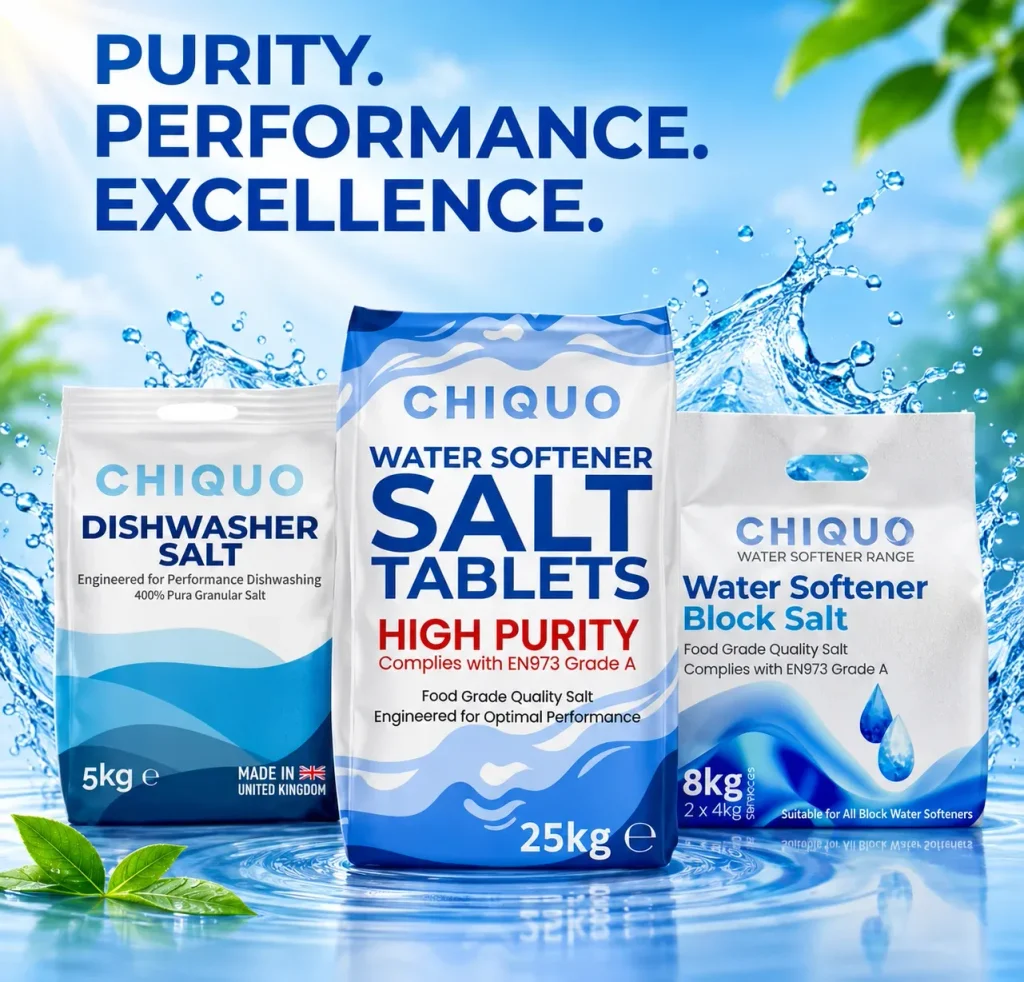
1. Chiquo Water Softener Block Salt, 8 kg (3-Pack)
Best for: Owners of block-salt water softeners.
| Detail | Listing information |
|---|---|
| Pack | 3 x 8 kg (24 kg total, 6 blocks) |
| Manufacturer | Maysi Foods Ltd (ref. MFBS83) |
| Specification | EN 973 Grade A |
| Reviews | 53 |
The listing describes it as high purity food grade salt that dissolves to form brine. A multipack costs more upfront than single blocks, but saves repeat purchases. Do not use it in a tablet-based softener. Check your manual for the salt compartment dimensions.
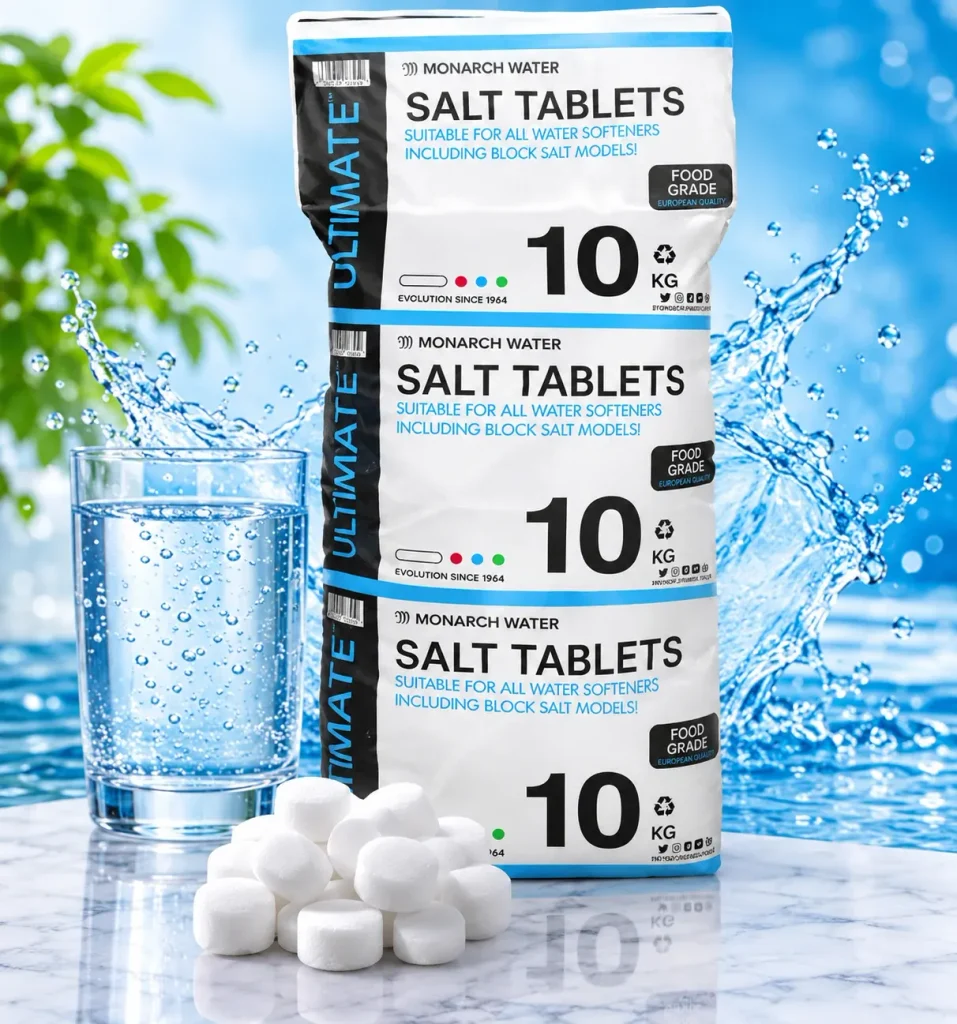
2. Monarch Water Ultimate Salt Tablets, 10 kg
Best for: Owners of softeners that use salt tablets.
| Detail | Listing information |
|---|---|
| Pack weight | 10 kg |
| Manufacturer | Monarch Water (model MTS10) |
| Specification | BS EN 973 Class A |
| Rating | 4.5/5 from 162 reviews |
The tablets dissolve to create brine that regenerates the resin. Verify that the specification matches your softener manufacturer’s requirements.
Block vs tablet salt: they are not interchangeable. Buy blocks if your softener needs blocks and tablets if it needs tablets. Compatibility matters more than price or pack weight.
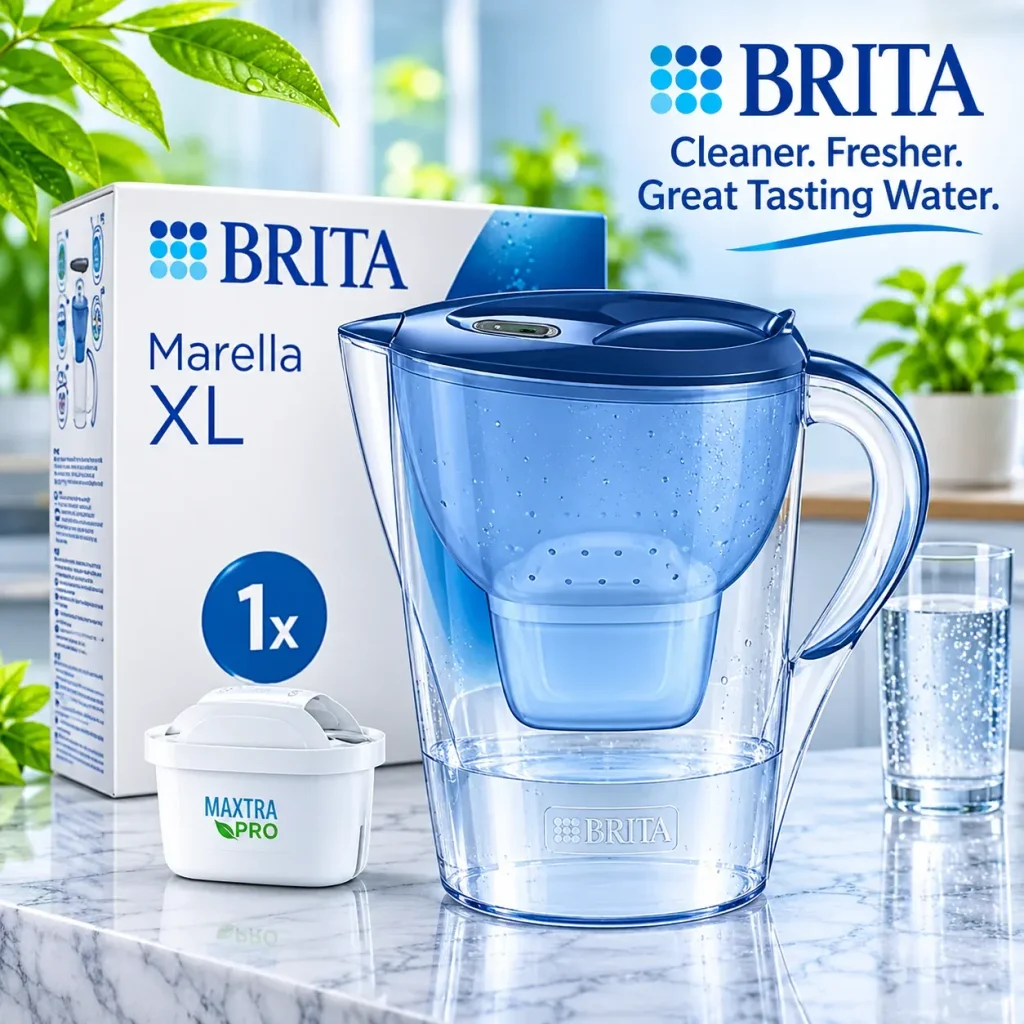
3. Amazon Basics MAXTRA PRO All-in-1 Water Filter Cartridges (6-Pack)
Best for: Replacing cartridges in a compatible jug filter.
| Detail | Listing information |
|---|---|
| Pack | 6 cartridges |
| Media | Activated carbon and ion exchange |
| Compatibility | Amazon Basics and BRITA filters, per the listing |
| Claims | Reduces chlorine, limescale, herbicides, pesticides, pharmaceuticals and metals such as lead and copper; BPA-free; TÜV certified |
Confirm compatibility with your jug before buying. A six-pack usually does not include a jug, although some listings bundle one. The manufacturer’s claims are only as good as the test data behind the TÜV certificate, and a handful of five-star reviews does not prove performance.
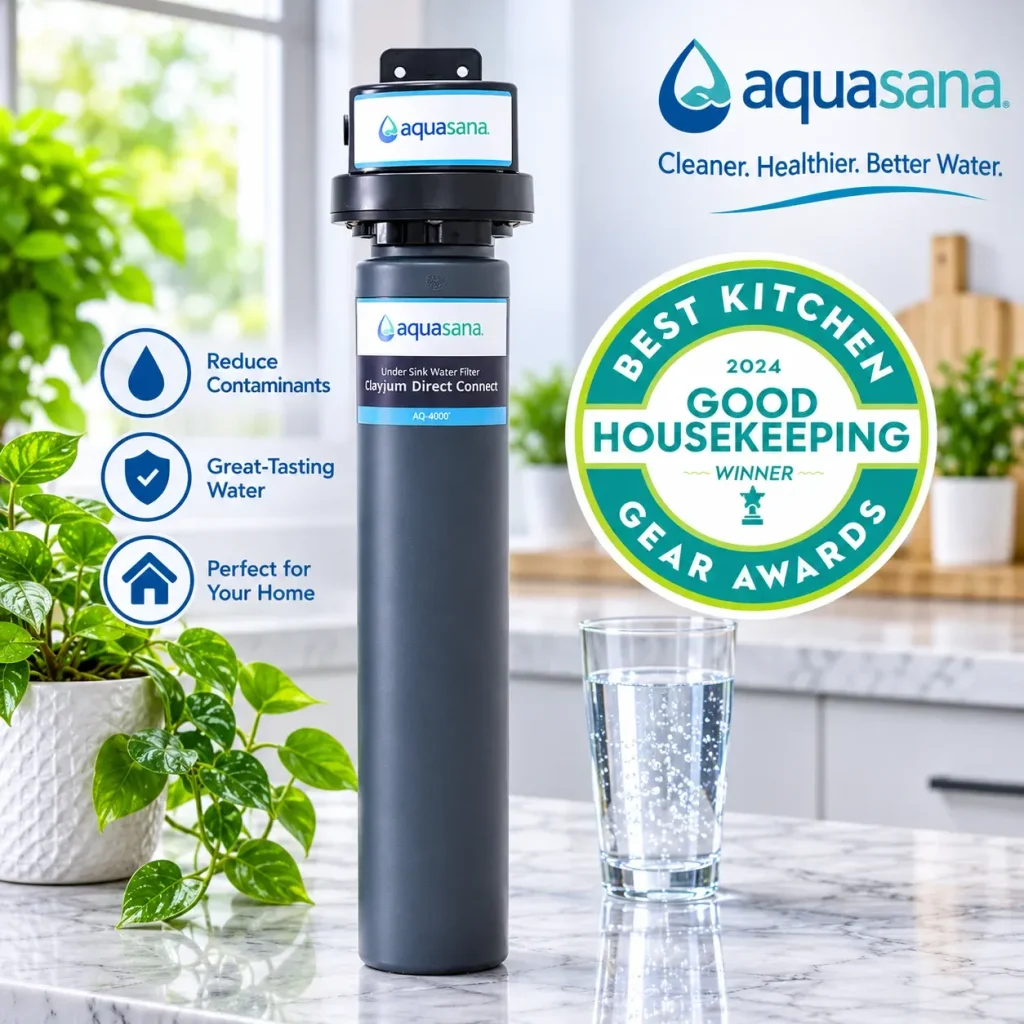
4. Aquasana Claryum Direct Connect Under-Sink Water Filter (AQ-MF-1)
Best for: Drinking water filtration under the kitchen sink.
| Detail | Listing information |
|---|---|
| Type | Under-sink filter on the cold supply line |
| Dedicated tap | Not required |
| Countertop drilling | Not required |
| Clearance | About 3 inches for filter changes |
| Rating | 3.9/5 from 460 reviews |
The manufacturer says it reduces 77 contaminants, including PFAS, mercury and asbestos, by up to 99%, while retaining minerals and not removing TDS. This is a filter, not a softener, so it will not stop limescale. Check certifications for the contaminants you care about, replacement filter cost and availability, flow rate and plumbing compatibility.
Which Product Fits Your Need?
| Your need | Product to investigate |
|---|---|
| Salt for a block-salt softener | Chiquo Block Salt |
| Salt for a tablet softener | Monarch Water Salt Tablets |
| Replacement cartridges for a compatible jug | Amazon Basics MAXTRA PRO |
| Under-sink drinking water filtration | Aquasana Claryum Direct Connect |
If you need a whole-house softener, do not buy salt first. Compare complete systems by salt tank capacity, size and weight, regeneration control, warranty and running costs.
What to Check Before Buying
- Identify your actual problem. Test hardness and ask your supplier about local water quality.
- Understand the technology. Ignore labels like “advanced filtration” or “scale protection” until you know how the product works.
- Size your softener correctly. Consider water hardness, household size, daily usage, rated capacity and regeneration frequency. Bigger is not always better.
- Check tested claims. Look for independent certification, such as NSF/ANSI 42 (chlorine taste and odour), NSF/ANSI 53 (health-related contaminants) and NSF/ANSI 58 (reverse osmosis systems). Certification covers specific contaminants, not everything, so verify the model number and the claims.
- Calculate total cost of ownership. Include salt, regeneration water, cartridges, membranes, servicing and installation.
- Check space and plumbing. Confirm fit, drainage, water pressure and flow. In the UK, use a qualified plumber and follow Water Fittings regulations.
- Confirm spare parts and support. Make sure genuine replacements are available in the UK.
Common Mistakes and Misconceptions
- “All filters remove hardness.” Most do not, so limescale will still form.
- “A softener removes all contaminants.” It does not remove lead, chlorine or other substances.
- “Any salt works.” Block and tablet salt are not interchangeable. Follow your manufacturer.
- “A high star rating proves it works.” Reviews reflect ease of use, not contaminant removal.
- Ignoring cartridge costs. A cheap filter with pricey, hard-to-find cartridges can cost more over time.
- Trusting broad marketing claims. “Removes 99% of impurities” says nothing about which impurities.
- Expecting a softener to remove existing scale. It prevents new scale only.
- Softening your drinking water. Keep an unsoftened supply for drinking and cooking.
Frequently Asked Questions
Should I buy a water filter or a water softener?
It depends on your problem. A softener is best for limescale and hard water. A filter is best for taste, odour and specific contaminants. Neither replaces the other.
Can a water filter soften water?
Only a few filters, such as some ion-exchange jug cartridges, reduce temporary hardness. A whole-house softener is far more effective.
Can a water softener remove chlorine?
No. You need an activated carbon filter or similar for chlorine.
Is softened water safe to drink?
Sodium-based softening adds sodium to water. The recommendation is to use unsoftened water for drinking and cooking, and never to prepare infant feeds with softened water. If you are on a low-sodium diet, seek medical advice.
Do water filters remove limescale?
It depends. Some ion-exchange jug filters reduce kettle scale, but ordinary carbon filters do not remove hardness the way a softener does.
Can I use a water softener and a water filter together?
Yes. A whole-house softener treats water throughout the home, and a drinking water filter treats water in the kitchen. The system must be designed and installed correctly.
Do water softeners remove existing limescale?
No. They prevent new limescale. Existing deposits need descaling.
Which costs more, a water filter or a water softener?
A filter jug costs less upfront, but cartridges add up. A softener costs more upfront, with ongoing costs for salt, regeneration water and servicing.
Should I get a softener or a reverse osmosis filter?
If hard water affects your whole house, choose a softener. If you want to reduce certain contaminants in drinking water, choose reverse osmosis.
When do I need a water softener?
When limescale is damaging appliances, clogging fittings or leaving stubborn white deposits throughout your home.
Final Verdict: Which Should You Buy?
- Limescale throughout the house? Buy a water softener.
- Taste, odour, sediment or a specific contaminant? Buy a tested water filter.
- Both problems? Use a softener plus a separate drinking water filter, with an unsoftened kitchen tap.
- Occasional use or small budget? A jug filter may do. For a whole household, an under-sink system is often a better fit.
Salt products from Chiquo and Monarch are only relevant if their salt format matches your softener. They are consumables, not filters. Look at the Aquasana system if you want under-sink filtration, and always review performance data, filter replacement costs and installation requirements first.
Choose the system that solves your real water problem at a cost of ownership you can live with. Don’t let price or marketing hype make the decision.