Enjoy Better Water! 9 Water Softener Benefits for UK Homes

The kettle is often where hard water makes itself obvious first. You open the lid and find a pale crust inside. Then you notice the ring around the bathroom tap, or the marks that come back on the shower glass soon after cleaning. None of these jobs is especially difficult on its own; having to repeat them is what gets tiresome.
Those deposits are commonly linked to calcium and magnesium in the water. The minerals occur naturally, but they can be left behind when water is heated or dries on a surface. If your supply is hard, cleaning the marks removes what has already formed without changing what comes out of the tap next time.
A conventional ion-exchange water softener takes a different approach. It lowers the amount of calcium and magnesium in the water treated by the unit. That can make a noticeable difference to fresh limescale, how soap lathers, and the amount of scale that collects in some appliances.
That does not make a softener the right purchase for every home. It is not a general water purifier, and claims about guaranteed savings or healthier skin go too far. People also differ in how much they notice the change to showering or washing their hair. The decision is best made after checking your local water hardness, the problems you want to solve, and the cost of owning the system.
Here are nine water softener benefits worth weighing up, alongside the limitations and the UK-specific details to check before arranging installation.
Key takeaways
- Fresh scale is less likely to form: Lower levels of calcium and magnesium help reduce new deposits on treated taps, shower screens and similar surfaces.
- Appliances may collect less scale: Kettles, washing machines, dishwashers and compatible hot-water equipment can benefit from reduced hardness.
- Cleaning may take less effort: There may be fewer new mineral marks to scrub away, although normal housework will still be needed.
- Soap usually lathers more easily: Lower hardness changes how soap behaves and can affect some detergents.
- The feel of washing may be different: Some people like the change to their skin or hair; others do not notice much.
- Descaling jobs may be less frequent: Certain items, such as kettles and showerheads, may need less frequent scale removal.
- Cleaning-product savings are not guaranteed: Product choice and household habits make a difference.
- One installation can serve several outlets: A suitably selected and installed system can treat water supplied to connected taps and appliances.
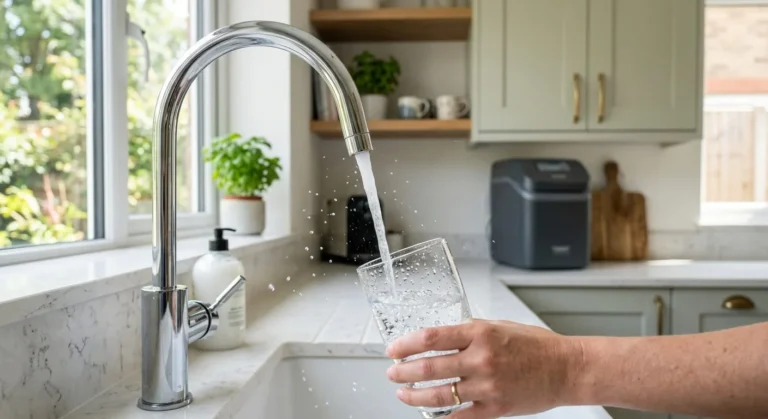
- Drinking water needs planning: UK guidance advises keeping an appropriate unsoftened supply for drinking and cooking when a conventional salt-based ion-exchange unit is fitted.
Table of contents
What a Domestic Water Softener Does?
A household softener treats water to reduce its hardness. Many conventional models do this by ion exchange: as water passes through the unit, calcium and magnesium ions are captured by resin and exchanged for sodium ions.
Hard water is not automatically unsafe to drink. For many homeowners, the more obvious issue is the scale it leaves behind, particularly in things that heat water and on surfaces that get wet repeatedly. A softener is designed to deal with this hardness problem; it is not intended to remove every substance in the water.
How hard and softened water differ?
| What you notice | Hard water | Water softened by ion exchange |
| Calcium and magnesium | Present at higher levels | Present at reduced levels |
| New limescale | More likely to form | Less likely to form |
| Soap lather | May be harder to build up | Generally forms more readily |
| Heated parts and appliances | Scale may collect | Less potential for scale buildup |
| Mineral marks on surfaces | May need frequent cleaning | Often easier to keep under control |
How much difference you see depends on the hardness of the untreated supply, the condition and settings of the softener, and which pipes and outlets receive its treated water.
For background on UK water-hardness categories, consult the Drinking Water Inspectorate’s guide to water hardness.
What Happens Inside the Unit?

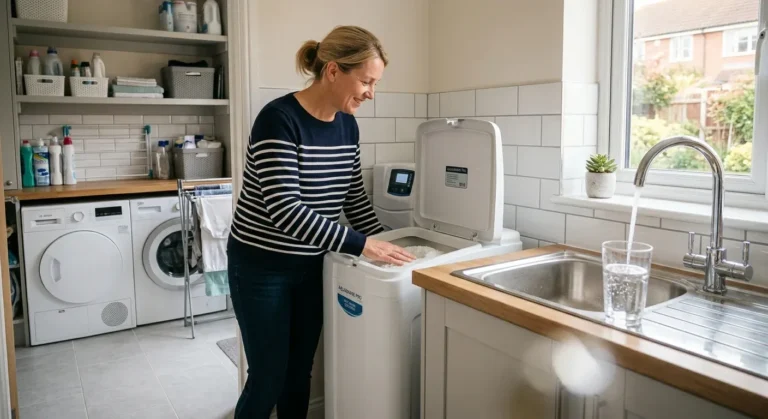
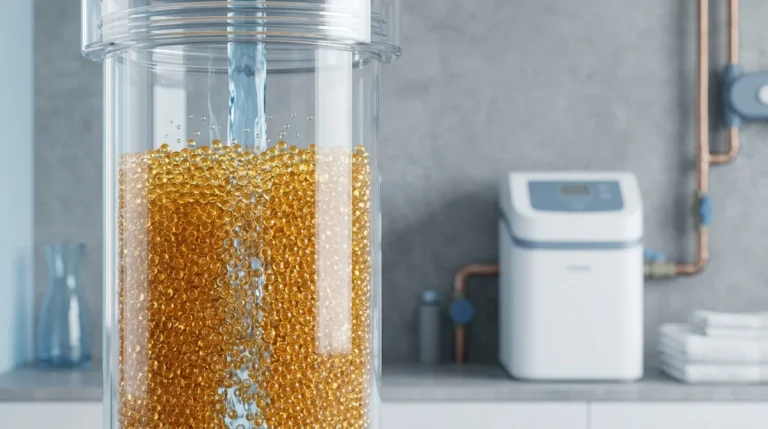
Inside many household systems is a bed of ion-exchange resin. Hard water passes through it; the resin holds onto calcium and magnesium, while sodium enters the water instead. The treated supply then travels to the outlets connected to the softener.
The resin has a working capacity. Once it has captured a certain amount of hardness minerals, the machine needs to regenerate it with a salt solution. Regeneration prepares the resin to keep softening the incoming water. That is why salt-based systems need a suitable salt supply and why regeneration is part of their normal operation.
There is an important distinction here: softening is not filtration. A conventional softener reduces hardness. It should not be relied on to remove every contaminant or to guarantee a particular drinking-water quality.
Nine Ways a Water Softener May Help at Home
1. Fewer new chalky deposits on taps and fittings
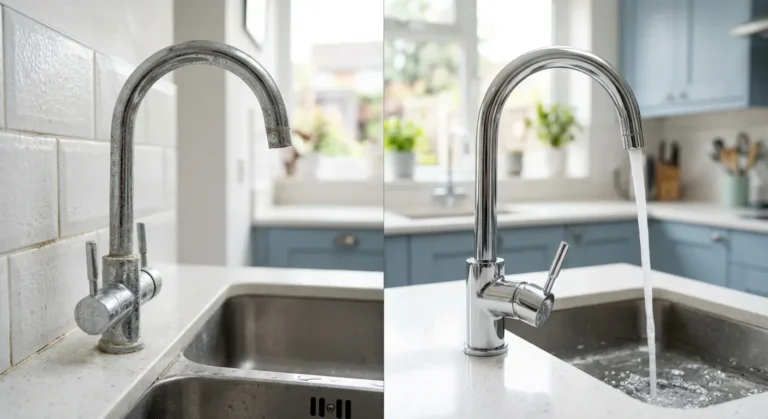
If hard water is leaving a white edge around the kitchen tap or a cloudy film on the shower screen, you are seeing one of the most common reasons people consider softening. Calcium and magnesium can leave deposits as water heats up or dries out.
Lowering the amount of these minerals in the treated supply reduces the material available to form new scale. In practical terms, the aim is to stop adding to the problem every time you use the sink, kettle or shower—not to make old scale vanish on installation day.
Existing deposits usually need to be dealt with separately. Use a cleaning product suitable for the surface and follow its instructions, especially on delicate finishes. After that, properly softened water can make it harder for the same kind of deposit to build up again on outlets connected to the system.
The benefits of a water softener are usually easy to evaluate from home. You should see how long it takes for new scale buildup to appear prior to installing a water softener. Then watch those same areas after installation. Your results will vary based upon the quality of your initial water supply (hardness) and if the water softener is functioning properly.
2. Less scale reaching water-using appliances
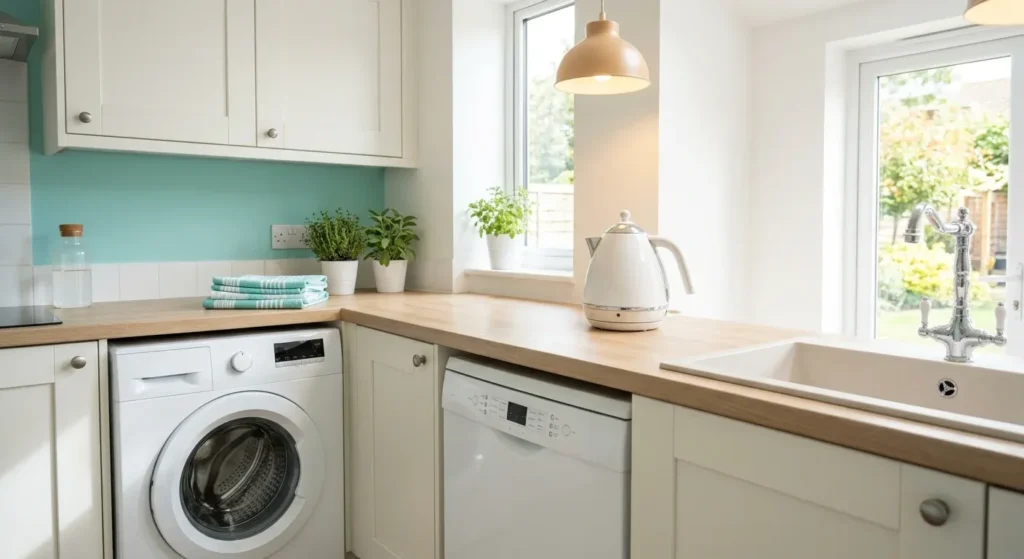
Scale is not limited to being a ring around a tap. It may also accumulate inside appliances that either use or heat water. Some examples include kettles, dishwashers, washing machines, coffee machines, showers, and other types of hot water-using equipment. However, the amount of scale accumulated will vary depending upon the design and how the appliance operates.
In areas where the water is “hard,” a kettle will likely have some scale (mineral) deposits forming on its interior surface within a relatively short period of time as a result of being used to heat water numerous times. Many of the other appliances in your home will also experience mineral deposit formations; however, these will be on components of the appliance which cannot be readily seen. If you use soft water for your appliances, the reduced hardness of the water should minimize the formation of such mineral deposits.
The Drinking Water Inspectorate includes reduced scale formation in hot-water systems and improved efficiency in appliances used for washing clothes and dishes among the potential advantages of domestic water softening.
That does not guarantee all appliances will have a longer life. Although removing scale eliminates one possible area of repair, the length of an appliance’s life depends upon many factors including product quality, installation practices, water conditions, usage, and routine maintenance. Therefore, no reputable manufacturer can provide a specific number of additional years for each type of appliance (e.g., kettle vs. washing machine).
If several devices in your house are experiencing problems with mineral buildup from hard water, then using a water softening system can provide an additional benefit. That is, it can help prevent at least some of the buildup that causes problems for your appliances, although it will not protect them from all possible types of damage.
3. Less time spent scrubbing mineral marks
Even though a bathroom may appear spotless, it can appear stained if water droplets dry on the plumbing fixtures and build up on the shower enclosure. Hard water will create mineral buildup again quickly after removal from the surface. Areas of the bathroom that are subjected to frequent splashing throughout the day will experience rapid mineral accumulation.
Treating the water can reduce the amount of new scale that forms on connected surfaces. That may mean descaling less often or needing less effort to remove fresh mineral marks. The difference is usually easiest to see in kitchens and bathrooms, where water contacts surfaces frequently.
Of course, this will not take general cleaning off your to-do list. Grease, dust, food spills, body oils and everyday dirt still need attention. A water softener does not replace household cleaning products; it reduces the hardness minerals behind one particular part of the work.
Some people would like to use water softening systems because they have problems with mineral buildup on their chrome hardware and/or difficulty keeping their shower door clean. The decision of whether the convenience provided by a softer water supply justifies the cost of purchasing and operating a water softening system will vary from person to person; however, there is certainly a valid functional reason for many individuals to consider installing a water softening system.
4. Soap can lather more readily
Hardness minerals may create soap scum when they come into contact with traditional soaps. Additionally, hardness minerals may make it more difficult for you to achieve a rich lather than with softer water. When there is less calcium and magnesium present, you will typically find that your soap lathers better.
You may notice this when washing your hands, bathing, showering, washing dishes, or cleaning bathroom surfaces. The performance of some laundry detergents can also be affected, although different products behave differently.
Does this suggest that you will purchase less soap or detergent? While it may be for some households, there isn’t a single “standard” amount of savings. There are several factors which determine how much product is used (i.e., product, dosage, size of family, daily routine) and as such, you cannot simply reduce the recommended dosage of laundry detergent based upon the fact that you now use a water softener. Instead, follow the manufacturer’s directions for your washing machine, detergent, and load.
The fair conclusion is that water softening changes how some cleaning products behave. If that translates into using less, it will show up in your own routine rather than being guaranteed in advance.
5. A different feel after washing your skin
Some people say their skin feels smoother, less coated, or more comfortable after a shower with softened water. Other people notice no real difference. Both experiences are possible, so this is best understood as a change some users report—not a promised outcome.
Soaps can act differently because of calcium and magnesium, which could be responsible for creating a layer of film. By changing the amount of hardness in the water, you change the way that washing and rinsing occur. This is perhaps why many people like the feeling of softened water; however, this doesn’t mean that a softener is beneficial to everyone’s skin.
Be wary of claims that a domestic softener will cure eczema, acne, dry skin or another condition. Skin problems can have many causes; water softening is not a medical treatment and should not replace advice from a qualified healthcare professional. If you have persistent irritation, get appropriate medical advice.
For a household without a particular skin condition, the realistic possibility is a more comfortable-feeling wash, whether you notice that difference is personal.
6. Hair may feel different after a wash
Hair is another part of the washing routine where people sometimes notice a change. The minerals in hard water can react with hair products, leading to a buildup of residue. With less calcium and magnesium in the treated water, some people say shampoo rinses out differently, or their hair feels less coated afterwards.
Experiences with this product may include the ability to rinse easily, a change in how your hair feels after it has dried, and/or a smoother texture during the process of washing your hair. However, because of differences in hair types, products used (shampoos/conditioners), how often you wash your hair, what temperature of water you use, and the state of your scalp, there are numerous potential outcomes. No single outcome can be promised to everyone.
A shower filter and a conventional water softener should not be treated as interchangeable products. A whole-house ion-exchange softener reduces calcium and magnesium. A shower filter may target other substances, depending on the media and design. Some compact products marketed as shower softeners do not carry out the same treatment as a properly sized ion-exchange unit.
For those whose primary concern is hair, read on to determine what a product does and whether the manufacturer can back up their claims about its effectiveness. The primary objective of a buildup softener will always be to reduce hard water and scale buildup. Any improvement to how hair feels would be an extra benefit.
7. Better conditions for washing clothes and dishes
Hard water changes the conditions in which detergents work. Lower hardness can help some products perform more effectively in suitable circumstances and can reduce scale in parts of a washing machine that come into contact with water.
The result is not identical in every laundry room. Detergent formulation, the wash programme, water temperature, fabric and machine condition all play their part. Some households might notice a difference in rinsing, residue, or how clothes feel after washing; others may see a smaller change.
While saying that soft water will provide a softer feel for all types of clothing or help maintain the appearance of your clothes forever would be an exaggeration. Clothes are subjected to wear and tear as they undergo multiple washes. In addition, the type of detergent used and how clothes are dried also influence their longevity.
If you find that a smaller detergent dose works for a particular load, stay within the guidance on the product and appliance. Too much can leave residue, while too little may not clean the laundry properly. In a home that washes clothes and dishes frequently, less scale and altered detergent performance may be useful—but judge the result from your own experience rather than expecting a set saving.
8. Cleaner-looking kitchen and bathroom surfaces
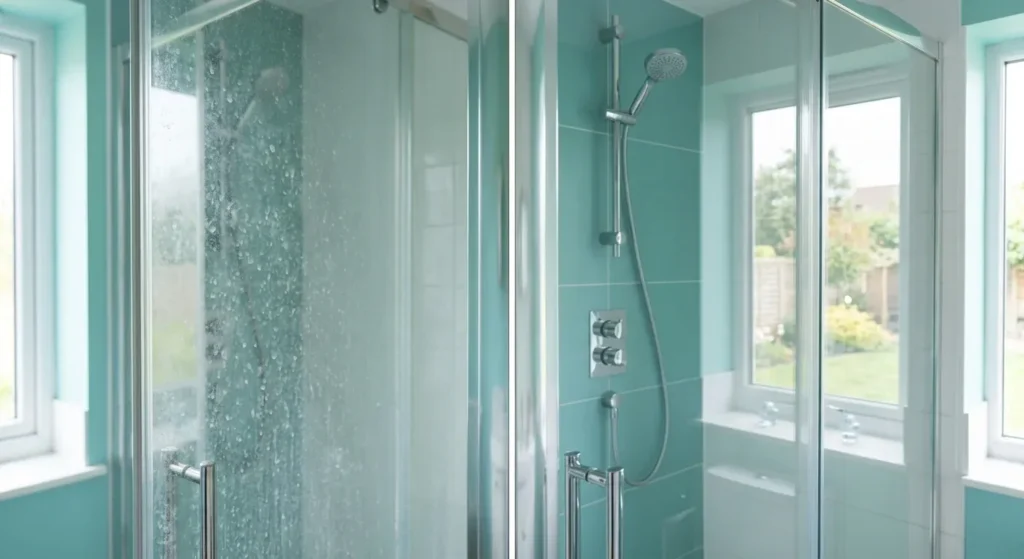
Hard water is typically very obvious around your kitchen and/or bathroom fixtures. You will probably notice dry spots on your taps from when you used the water last, cloudiness on your shower doors or a white layer on the inside of your kettle. Since these areas are used frequently, you may find that the hard water deposits return to the area after you have cleaned it. A softener that is correctly installed can reduce hardness minerals reaching the outlets it serves. This helps limit fresh deposits, particularly in homes with several bathrooms, regularly used showers, glass or chrome fittings, or a supply with high hardness.
No matter how good a water softener works, it won’t prevent all stains. You will still have to clean up regular dirt; you’ll find that your drops of water cause staining, and any existing scale you had before you installed the water softener will continue to exist until you remove it. Your success with a water softener depends on whether the faucets and appliances that use the water are connected to the water softener. If they aren’t, the water softener will not be able to treat them.
The benefits of using less scale are beyond what you see. In fact, if there’s less scale accumulation, some showerhead and/or fitting replacements might be required less frequently for descaling. When you have a busy home, having a repetitive task reduced or eliminated altogether may be more valuable than having a long list of features that sound impressive.
9. Fewer scale-related jobs to keep on top of
Put the previous points together, and the overall convenience becomes clearer. If less limescale forms, you may not have to descale the kettle as often, clear deposits from a showerhead so frequently, or keep removing chalky marks from taps and bathroom fittings. Scale in suitable appliances may also be easier to manage.
A softener does bring its own upkeep. Salt-based systems need the salt supply monitored and replenished, and their performance, cleaning, and servicing should be handled according to the manufacturer’s instructions. The installation does not mean maintenance disappears; it changes the kind of maintenance you may need to do.
The decision is a trade-off. On one side is the effort and cost associated with hard-water deposits. On the other are the purchase price, fitting, salt, and other maintenance costs of the softener. Some households will feel the reduction in cleaning is well worth it. Others may decide that the convenience is not enough to justify a new piece of equipment.
Prior to selecting a model, determine the local hardness of the water, and also find out exactly what specific household jobs you would like to have decreased in frequency. This will provide a clearer understanding of how effectively the product suits your requirements, rather than relying on a broad claim that a water softener will render your entire home “maintenance-free.”
Is a Water Softener Worth Buying in the UK?
For a home where limescale keeps returning, a softener may be worth investigating. If the supply is already soft or deposits are rarely a problem, the benefit may be limited. Location alone does not decide it; the actual water supply and the way your household uses water matter more.
A system is more likely to be worth considering if your supplier describes the water as hard or very hard, the kettle scales up regularly, or you spend time cleaning deposits from taps, shower screens and bathroom fittings. It may also suit a household that wants to reduce scale in suitable appliances or have softened water at several connected outlets.
The case is less compelling if limescale barely appears, your main concern is taste rather than hardness, or you need to remove a particular contaminant. A softener is not a substitute for a treatment system designed for that contaminant: installation space, plumbing arrangements and willingness to look after the unit matter too.
You can start with the Drinking Water Inspectorate’s water hardness guidance. Your water supplier may also publish details about the supply in your area.
Work out the full cost
The price on a product page is only one part of ownership. Depending on the model, you may also need to budget for professional installation, salt, servicing, replacement parts, and any electricity or water used by the system. Against that, some homes may spend less time descaling or use less soap and detergent, but those outcomes are not certain.
Treat headline saving estimates with care if it is not clear how they were calculated. The result in your own home will depend on the incoming hardness, how much water your household uses, the equipment selected and how well it is maintained.
The Benefits and the Trade-Offs
| What you might gain | What to think about first |
| Less formation of new limescale | Purchase and fitting cost |
| Reduced scale in suitable appliances | Ongoing care is still required |
| Easier control of some cleaning tasks | Salt-based models need salt replenishment |
| Soap may lather more readily | Sodium levels in treated water increase |
| Washing may feel different | Skin and hair experiences vary by person |
| Some descaling jobs may become less frequent | A softener does not replace filtration |
| Several outlets can be served by one installation | Plumbing and drinking-water arrangements need attention |

One UK-specific point deserves attention before installation. An ion-exchange softener swaps calcium and magnesium for sodium, and the amount of sodium added depends partly on how much hardness is removed.
UK drinking-water advice: The Drinking Water Inspectorate advises households to retain an unsoftened supply at the kitchen tap for drinking and cooking. Its guidance also says not to use artificially softened water to prepare baby feeds. If a member of your household has been told to limit sodium, seek appropriate professional advice before changing the drinking-water supply.
Read the DWI information on domestic water filters and softeners when considering your options.
Salt-Based Softeners and Salt-Free Conditioners Are Different
Products designed for hard-water problems do not all treat the water in the same way. The name on the box is not enough; look at the mechanism and what the manufacturer can demonstrate about its performance.
Salt-based ion-exchange systems
These are the conventional softeners described in this guide. They reduce calcium and magnesium in the water treated by the unit. If you want conventionally softened water and lower hardness, this is the technology to investigate. It requires proper installation and ongoing attention to salt and regeneration, along with the maintenance specified by the manufacturer.
Salt-free conditioners
Most salt-free water conditioners work by changing the manner in which scale forms and/or acts. Therefore, these types of products do not use traditional ion-exchange methods to remove calcium and magnesium. Since there are many ways to achieve this goal with varying levels of success, each product must be evaluated on an individual basis.
The Drinking Water Inspectorate explains that physical conditioning devices do not actually soften water because they leave the hardness ions in place. Before buying a conditioner, find out exactly how it works and look for credible evidence relevant to conditions like those in your home.
Before comparing prices, decide what outcome you need. A product sold as a “conditioner” or “scale reducer” may not deliver the same result as an ion-exchange softener.
Which Homes May Notice the Biggest Difference?
A softener is most relevant where hard water causes a recurring nuisance. The more obvious the scale problem, the easier it is to judge whether reducing hardness helps.
- Homes in hard-water areas: If taps, kettles and showerheads collect deposits quickly, treating the water may reduce fresh scale.
- Properties with several bathrooms: A single unit of water treatment system can support several connected outlets, and therefore, this option can provide more convenience than treating each individual outlet.
- Households that wash clothes and dishes frequently: Lower hardness can affect detergent performance and help limit scale in relevant appliances.
- People tired of repeated descaling: If mineral buildup is a regular cleaning job, preventing some of the new buildup may be worthwhile.
- Homes with soft water or little visible scale: The change may be too small to justify equipment and upkeep.
A softener is a tool for a particular water problem, not a necessary upgrade for every home.
A Simple Way to Decide
Step 1: Establish the hardness
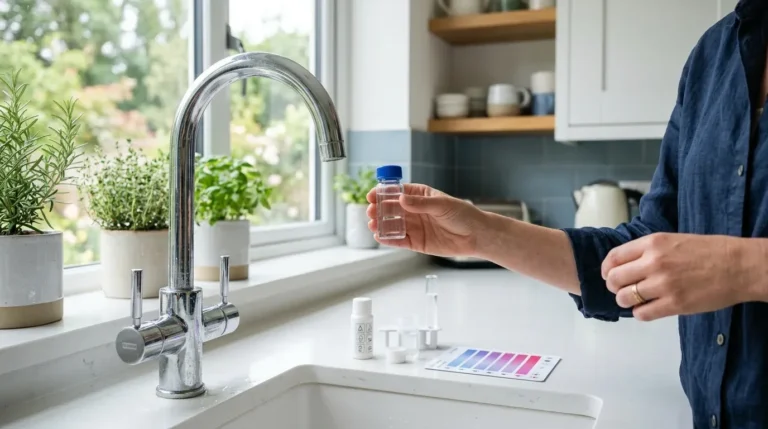
Use information from your water supplier as a starting point. If you need to test water from your property, choose a suitable hardness test and follow the instructions. Hardness is commonly expressed as milligrams per litre of calcium carbonate (mg/L as CaCO₃).
Step 2: List what is bothering you
Be precise: the kettle requires descaling every couple of days; there are white deposits building up around the faucets; the shower screen will look foggy after a short period of time; and you can see scale forming in appropriate appliances. A brief list of recurring issues would be more beneficial than buying based upon general claims.
Step 3: Match the treatment to the problem
If you mainly want to reduce hardness and limescale, a suitable softener may be the right kind of system. If you are concerned about taste or a particular contaminant, research treatment designed for that job. Softening should not be confused with filtration or specialised contaminant removal.
Step 4: Compare ownership costs
The first thing that should be considered when purchasing is the cost of the system as well as its installation costs, salt usage, maintenance costs, operating costs, and projected maintenance schedule. After considering build-up factors, think about what it means to have less scale build-up in your home and easier cleaning. Don’t base your estimates on the seller’s estimates of your household.
Step 5: Check the installation before committing
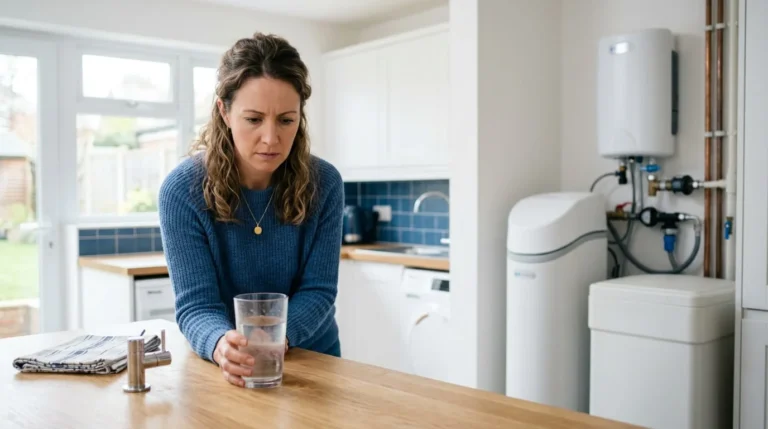
Use a professional supplier and a knowledgeable installer who understands the current UK water fitting rules. Inquire as to how the unit is going to be hooked up to your plumbing, and make sure that a usable amount of un-softened water is still accessible for drinking and cooking purposes.
Step 6: Make sure the routine is manageable
Find out how often the equipment needs salt, cleaning, inspection, or servicing. Check the manual and consider whether the model suits your property and the amount of water you use. The best fit is one you can maintain properly—not simply the product with the most attractive headline claim.
Six Common Claims, Put in Context
“A softener removes every impurity.” No, it does not. The conventional water softener is primarily designed to remove hard water minerals and can’t be used to provide all types of filtration or water treatments.
“Old limescale will disappear once the unit is installed.” The treatment changes the hardness of the water going through the unit. Deposits already formed may still need to be cleaned.
“Softened water will fix skin and hair problems.” Some people notice a different washing experience, but results vary. A domestic softener is not a medical treatment.
“Every household saves money.” Savings depend on the water hardness, how the household uses water, the equipment and installation costs, and the maintenance required. They should not be assumed in advance.
“A salt-free conditioner works just like an ion-exchange softener.” The technologies can work differently. Some conditioners leave hardness minerals in the water, so check the mechanism rather than relying on a product name.
“All household taps should receive softened water.” UK Drinking Water Inspectorate guidance advises keeping an unsoftened supply for drinking and cooking when a conventional ion-exchange softener is fitted.
Frequently Asked Questions
What are the main water softener benefits?
The main advantages are reduced formation of new limescale, less scale in suitable appliances, easier removal of some mineral deposits and better soap lathering. Some people also report a change in the feel of their skin or hair after washing, but that is not universal.
Is a water softener worth it in the UK?
It may be useful if your property has hard water and you regularly deal with limescale. Check local hardness first, then weigh the possible convenience against installation and running costs.
Does a water softener prevent limescale?
With the use of a conventional ion exchange water softener, you are reducing the levels of both Calcium and Magnesium present within your treated water. This means that you are effectively stopping the formation of additional limescale. However, there is no way that the conventional ion exchange water softener can instantly eliminate the existing lime scale on the surface.
Can it protect appliances?
It can decrease the amount of scale build-up in water-using or water-heating appliances. The extent of an appliance’s life cannot be guaranteed through scale prevention alone; other factors such as design, installation, use, and regular maintenance will determine how long an appliance lasts.
Is softened water better for skin?
Some people prefer the way it feels after washing, but experiences differ. A water softener should not be treated as a cure for eczema, acne, dryness, or another skin condition.
What about hair?
Some people notice easier rinsing or a different texture after washing. Hair type, products, washing habits, and other factors influence the result, so it is not guaranteed.
Can I cut down on detergent?
Possibly, in some circumstances, but do not change the dose automatically. Follow the instructions supplied with the detergent and appliance.
Is softened water filtered water?
No. A conventional softener reduces hardness minerals through ion exchange. Filters use other methods to target particular substances, depending on the design and filter media.
Should I drink water from a softener?
The UK Drinking Water Inspectorate advises retaining an unsoftened kitchen supply for drinking and cooking with a domestic ion-exchange softener, because the process adds sodium. Its guidance also says not to use artificially softened water to make baby feeds.
Does a water softener need maintenance?
Yes, salt-based water softeners require a consistent supply of salt and regeneration, along with the regular inspections and maintenance that are recommended by the manufacturer. The amount of attention required will depend upon both the type of water softener and how much water your family uses.
Final Verdict: Are the Benefits Worth the Cost?
The best reason for installing a traditional water softener is to deal with mineral buildup from hard water. The softeners will lower the levels of calcium and magnesium in the treated water. As a result, they may be able to slow down the formation of new limescale, reduce the amount of scale that builds up on some appliances, require less repetition when doing some types of cleaning tasks, and allow for better lathering of soap.
Some households also prefer the feel of softened water when washing. Others may not notice much change in skin or hair, and a softener cannot promise a fixed saving or longer appliance life. It also needs proper installation and its own maintenance.
Before making your decision, you should consider three factors: How hard is the water at your home? What problems would you like to alleviate? Is the potential benefit worth the initial expense and ongoing maintenance?
Check your supply, compare products that use the right treatment method, and plan for the recommended drinking-water arrangement. The aim is not to buy equipment because it sounds like an all-round improvement. It is to choose a system that addresses the hard-water problems you actually have.
Next steps
- Find your local water-hardness information.
- Make a note of where scale causes the most trouble.
- Compare ion-exchange softeners with other treatment options.
- Include fitting, maintenance and running costs in the budget.
- Retain an appropriate unsoftened supply for drinking and cooking.
- Choose a system suitable for your property before buying.
Have you noticed a difference since fitting a water softener? Leave a comment and share what changed in your home.
Sources:
1:https://www.amazon.co.uk/s?k=shower+screen+squeegee&utm_source
2:https://www.amazon.co.uk/s?k=water+softener+salt+tablets&utm_source
One Comment