Save Your Washing Machine! Water Softener for Washing Machine: 5 Key Benefits
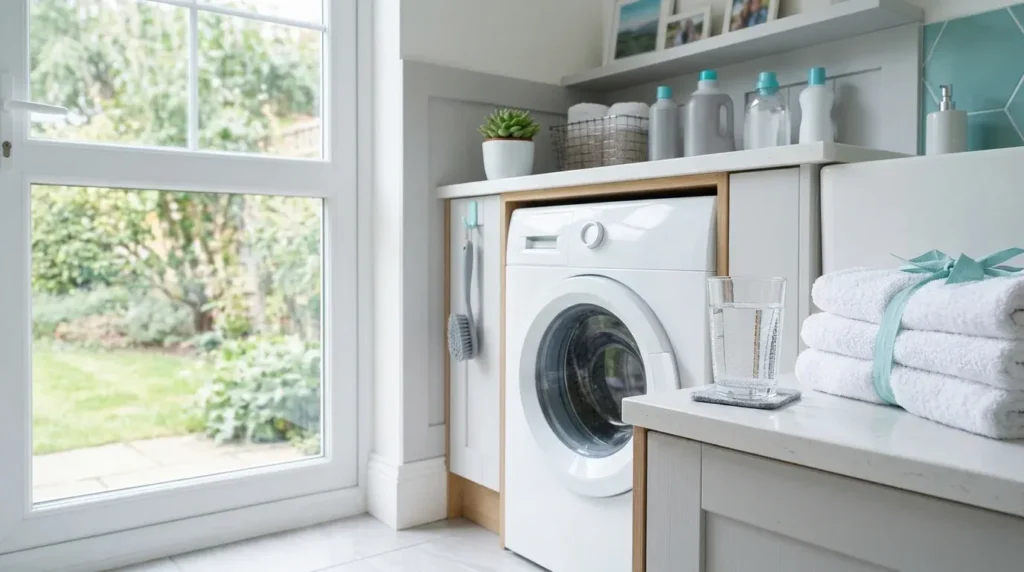
Hard water is hiding in your washing machine every wash day. A water softener for washing machine can help reduce limescale by lowering the minerals that build up on parts exposed to water and heat.
If you live in a UK hard-water area, the right water softener for a washing machine can help. But a full home system is not always practical, and it is not always necessary. Depending on your water hardness, budget and household, a laundry anti-scale product plus regular maintenance may be enough.
Here is the distinction that saves most people money: a domestic water softener treats the water supplied to connected appliances, while laundry anti-scale products are used with individual wash cycles. They are not interchangeable, and they do not deliver the same results.
Below you will learn how hard water affects washing machines, how softeners work, which options are worth considering in the UK, and how to choose without overspending.
Quick answer: A properly working ion-exchange water softener reduces calcium and magnesium (the hardness minerals) in treated water, which helps reduce the conditions that cause limescale. If you only want to manage scale in one washing machine, compare laundry-specific treatments before investing in a whole-house system.
Key Takeaways
- Hard water carries dissolved calcium and magnesium, which can contribute to limescale in washing machines.
- A domestic ion-exchange softener reduces hardness minerals in the treated water supply.
- Softened water can change how detergent performs and how much you need.
- Washing-machine tablets and gels are a targeted option, not a substitute for a whole-house softener.
- Living in a hard-water area does not automatically mean you need a softener.
- Correct detergent use, maintenance and manufacturer guidance still matter with softened water.
- When installing a domestic ion-exchange softener, keep an unsoftened drinking-water outlet.
Table of Contents
What Is a Water Softener for a Washing Machine?
Short answer: It is either a plumbed-in domestic softener that treats the water entering your home, or a laundry-specific tablet or gel used in individual wash cycles. Knowing which one you mean is the first step to a good decision.
How Does a Water Softener for Washing Machine Work?
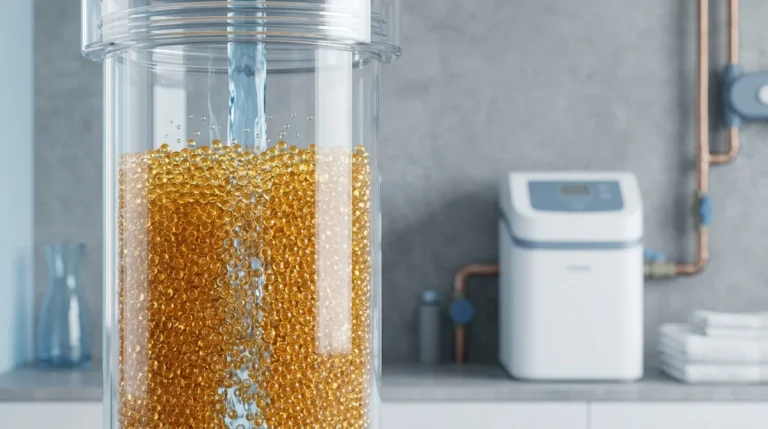
Most domestic softeners use ion exchange. Hard water contains calcium and magnesium ions. In a typical salt-based softener, water passes through a resin bed that swaps those ions for sodium ions. The resin is regularly regenerated with a salt solution so it keeps working.
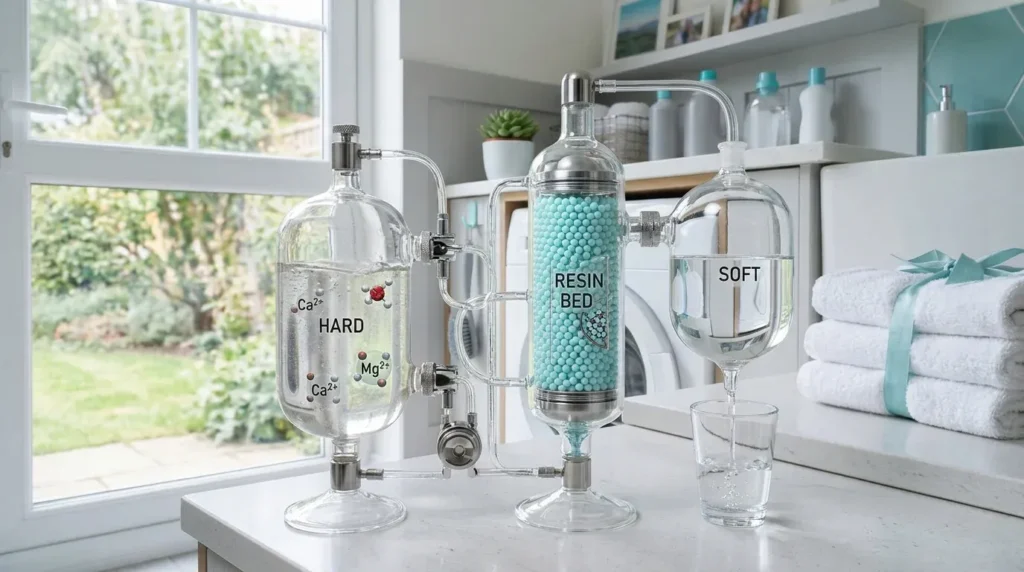
The result is water with far less calcium and magnesium hardness. According to the UK’s Drinking Water Inspectorate (DWI), this kind of softening can reduce scale in hot-water systems and improve lather and the efficiency of appliances used for washing clothes and dishes. See the DWI guidance on domestic water filters and softeners.
What about washing-machine softening products?
Laundry tablets and gels are made for individual wash cycles. Depending on the formula, they may help manage limescale or improve washing conditions, but do not assume they remove hardness minerals from your whole supply. A product added to the drum does not treat the water going to your shower, kettle or dishwasher.
The key difference: a plumbed-in softener treats the incoming supply; a laundry product treats one appliance according to its label.
How Does Hard Water Affect a Washing Machine?
Short answer: Hard water can leave limescale on heating elements and other surfaces exposed to mineral-rich, heated water, which over time may reduce efficiency and add wear. It is not the only cause of washing-machine problems.
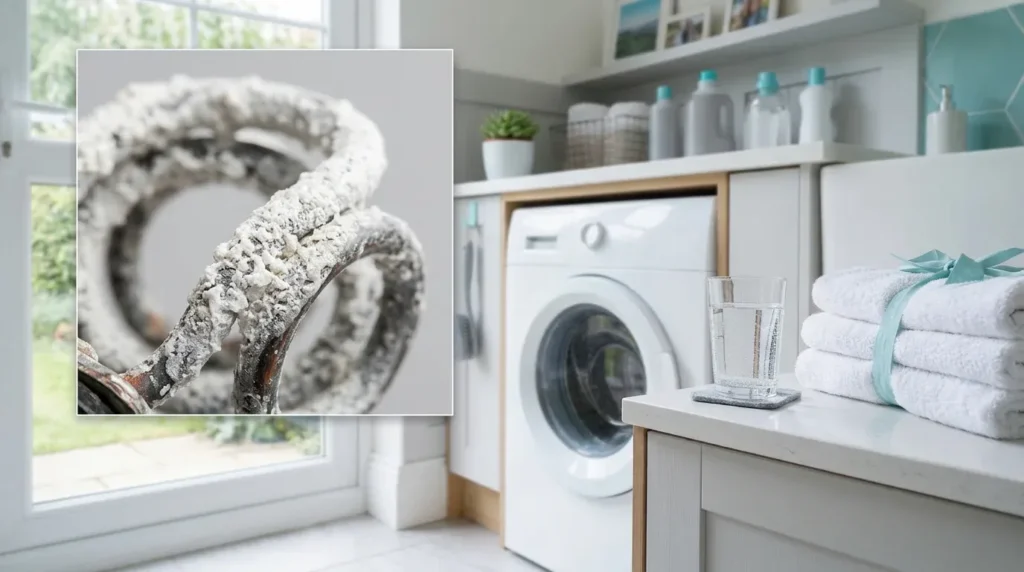
Hardness varies across the UK because local geology affects which minerals enter the water. The DWI states that hard water forms scale deposits on heating elements and other surfaces in contact with it, and that these deposits can reduce appliance efficiency and cause premature wear on some parts.
Where can limescale build up?
- Heating elements
- Internal surfaces exposed to water
- Water pathways and related components
- Areas where mineral-rich water is heated or evaporates
How much forms depends on water hardness, temperature, machine design and how often you wash. Heat matters because calcium and magnesium compounds precipitate out as scale, which is why kettles, boilers and hot-water systems are so often affected.
Still, limescale is not the only suspect. Detergent residue, trapped dirt, damp, blocked filters, mechanical wear and electrical faults can all affect performance. A softener tackles hardness; it does not prevent every washing-machine problem. For more, see the DWI guide to water hardness.
Does a Water Softener Help a Washing Machine?
Short answer: Yes. A properly working water softener reduces the hardness minerals entering your machine, which helps reduce limescale-forming conditions. It is not a guarantee of cleaner clothes, lower bills or a longer-lasting appliance.
A domestic softener can supply treated water to your washing machine, dishwasher and other connected outlets, depending on your plumbing. Potential benefits include:
- Less exposure to hardness minerals
- Lower risk of hardness-related scale build-up
- Different detergent performance compared with untreated hard water
- Easier scale management across several connected appliances
Results depend on your water supply, the system’s performance and how you use the machine. Do not assume savings without evidence.
Can a softener protect or repair your machine?
It can lower one risk factor. It cannot repair a damaged heating element, blocked pump or faulty electronics, and it cannot promise a longer lifespan. Lifespan depends on build quality, usage, maintenance, detergent, wash temperature and wear. If your machine leaks, makes unusual noises, throws frequent error codes or stops heating, check the manufacturer’s troubleshooting guide or call a qualified technician rather than assuming limescale is the cause.
Is a whole-house softener always necessary?
No. If the washing machine is your only concern, the upfront cost and installation of a whole-house system can be hard to justify. If scale also affects taps, shower screens, kettles and other appliances, whole-house treatment becomes more relevant.
Whole-House Water Softener vs Washing-Machine Treatment
| Feature | Whole-house softener | Laundry-specific treatment |
| Treats incoming water | Yes, for connected outlets | Generally no |
| Reduces hardness via ion exchange | Yes, for a typical ion-exchange model | Not necessarily |
| Used per wash cycle | No | Usually |
| Benefits other appliances | Yes | No |
| Plumbing installation | Usually required | Usually not |
| Ongoing supplies | Salt (salt-based systems) | Depends on product |
| Best for | Wider hard-water problems | Targeted laundry care |
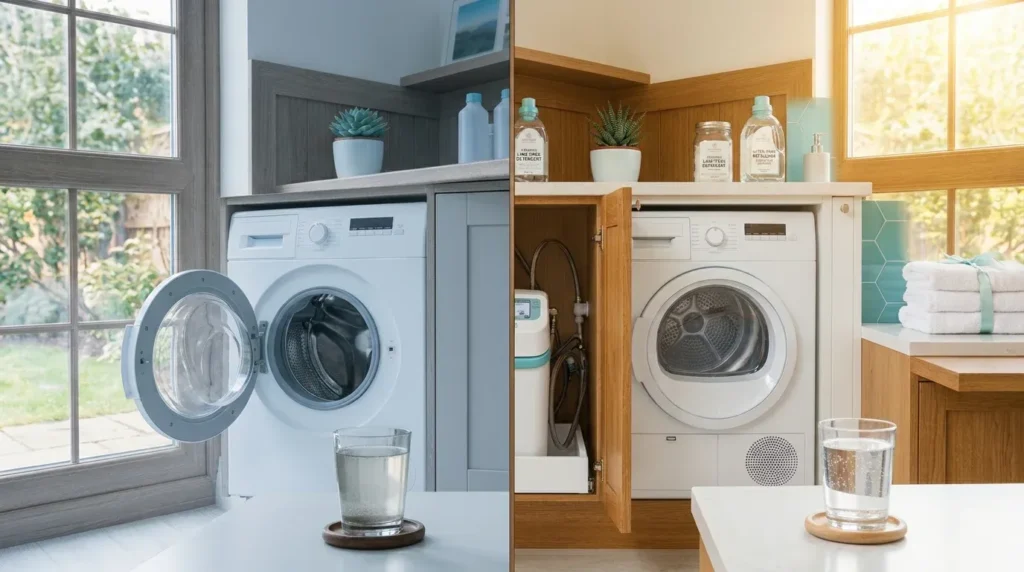
Choose a whole-house softener if hard water affects the whole property and you can install one. Choose a laundry treatment if the washing machine is the main concern and you want to avoid plumbing work. Neither is automatically best; compare treatment method, instructions, running costs and expected use.
Can You Use Softened Water in a Washing Machine?
Short answer: Generally yes, when the machine and the softener are compatible and installed to their manufacturers’ instructions. Softened water can change how detergent behaves, so check your manuals first.
Check these three things before connecting:
- Washing-machine manual: incoming water requirements, detergent dosage and compatible treatment products.
- Softener instructions: installation requirements, operating conditions and maintenance schedule.
- Your plumbing: the right supply is connected and the work complies with UK water-fitting requirements.
What about drinking water?
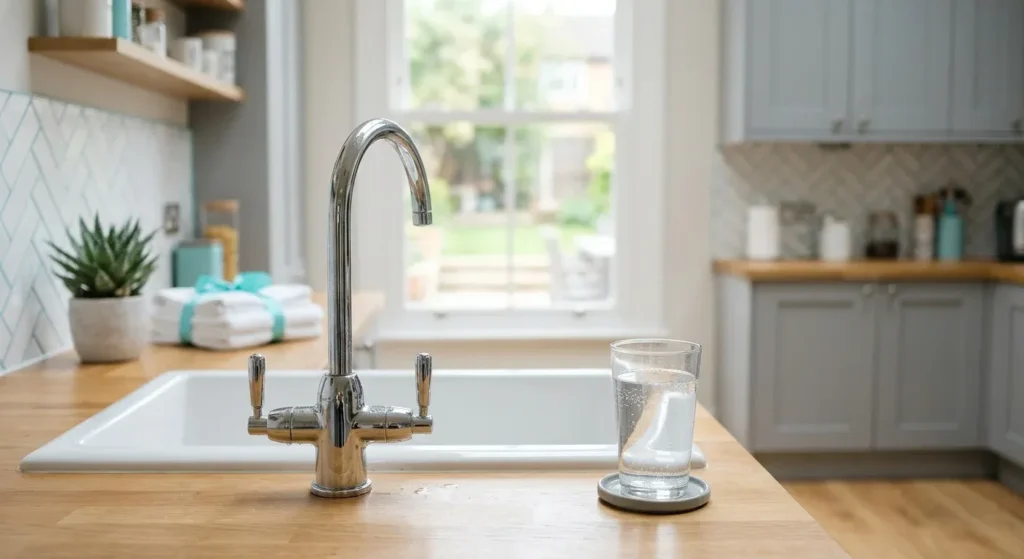
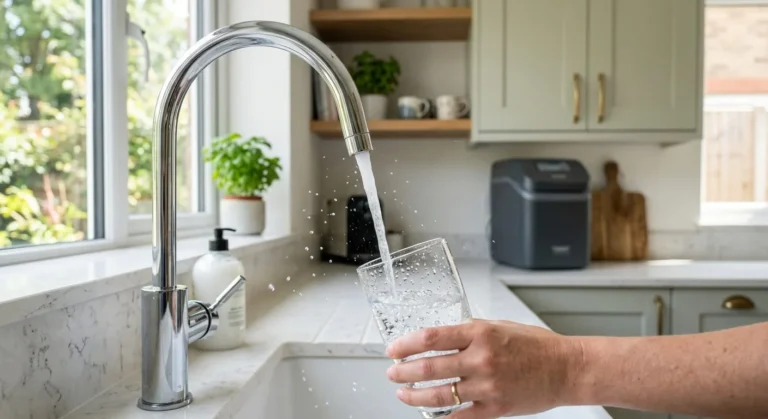
This is a key UK consideration. The DWI advises keeping an unsoftened outlet for drinking and cooking when installing a domestic base-exchange softener, because these systems replace calcium and magnesium with sodium. Artificially softened water should not be used to prepare infant formula. Follow NHS guidance and seek advice if sodium intake is a concern. A qualified plumber can arrange the installation so your washing machine gets treated water while a drinking-water tap stays unsoftened.
Best Water Softener for a Washing Machine in the UK
Short answer: The best choice depends on your water hardness, how many appliances are affected, your budget and the type of treatment you need. For several affected appliances, a whole-house ion-exchange softener usually makes sense. For one machine, a compatible laundry product is often enough.
Option 1: Whole-house ion-exchange softener
Treats the supply entering your home before it reaches connected appliances. Typically includes a resin bed and, for salt-based models, a brine tank or salt compartment for regeneration.
Pros: reduces hardness minerals in treated water; supplies multiple appliances; addresses the cause rather than one wash cycle; useful where scale affects several areas.
Consider: higher purchase and installation cost; ongoing salt; servicing; space, drainage and plumbing needs; a required unsoftened drinking-water outlet.
Option 2: Washing-machine water-softening tablets
Used with individual wash cycles according to the label. Ingredients and directions vary, so check the exact product.
Good fit if: you want a targeted laundry solution, you rent and cannot change plumbing, or you want to avoid the upfront cost of a household system.
Check compatibility with your machine and detergent, the dosing, and whether regular use is recommended. Never exceed the stated amount hoping for extra protection.
Option 3: Washing-machine water-softening gel
Sold to help manage limescale during washing. Formulations, dosage and intended uses differ, and some specify amounts by water hardness. Read the label closely. A gel is not equivalent to a plumbed-in softener unless the manufacturer clearly describes a genuine water-treatment system with technical specifications.
Where to start: one affected appliance, compare the long-term cost of a suitable laundry product against whole-house treatment. Several affected appliances, look into properly specified domestic softeners. The goal is a solution that matches your actual problem, not the biggest system available.
How to Choose the Right Water Softener
Step 1: Check your water hardness. Hardness varies by location, so do not rely on general UK statements. Ask your water supplier or use a suitable test kit. The DWI notes that hardness depends on local geology and recommends contacting your water company for an accurate measurement.
Step 2: List what is affected. Washing machine, dishwasher, kettle, shower and bathroom fittings, hot-water system, or several areas? A laundry-only problem may need only a targeted fix; whole-home scale deserves a closer look at household treatment.
Step 3: Compare total cost. For laundry products, count how often you rebuy and how much each wash uses. For a domestic softener, include the system, professional installation, salt, servicing and other running costs.
Step 4: Check installation requirements. Confirm water supply compatibility, space, drainage, maintenance access and any electrical needs. Use a qualified plumber and check compliance with water-fitting regulations.
Step 5: Review maintenance. Salt-based systems need salt and servicing per the manufacturer. Laundry products have their own dosage rules. Pick something you can keep up consistently.
How to Protect a Washing Machine From Hard Water
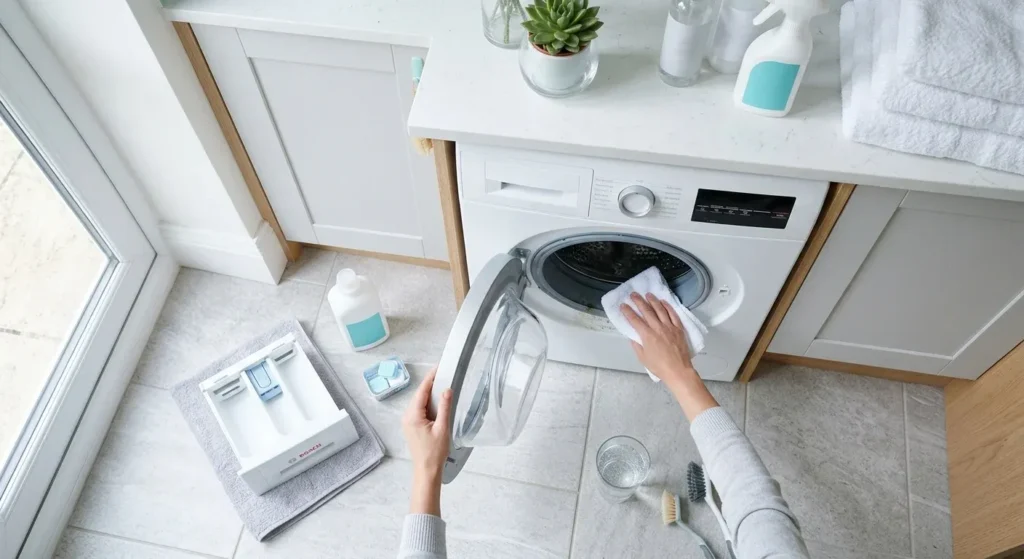
You do not need an expensive system to start managing scale. A simple routine helps:
- Establish your water hardness from your supplier’s data or a test kit, rather than guessing from how your kettle looks.
- Follow the appliance manual for detergent type, dose, wash frequency and limescale advice.
- Pick a scale-management approach that fits: a domestic softener, a compatible laundry anti-scale product, or regular descaling.
- Clean the machine regularly: filter, door seal and detergent drawer as the manufacturer advises. Leave the door ajar between washes so the drum can dry. Do not dismantle electrical or plumbing parts unless the manufacturer says it is safe.
- Descale when necessary with a product made for washing machines and follow its instructions. More frequent treatment is not better treatment.
- Investigate persistent problems. Recurring deposits or poor cleaning may point to an underlying fault, so check the manual or call a technician.
Does Soft Water Reduce Detergent Use?
Short answer: It can change how much detergent you need, because calcium and magnesium interfere with some cleaning agents. Do not cut your dose automatically; follow the detergent and machine instructions.
Many detergent makers give dosage guidance by water hardness. The right amount depends on the detergent type, load size, how soiled the clothes are, your water hardness and wash conditions. Adjust only as the manufacturer recommends.
Washing Machine and Dishwasher: Do You Need Both?
Not necessarily. A correctly sized and installed whole-house softener can supply treated water to both appliances, so you do not need one per appliance. However, many dishwashers have their own softening mechanism and need dishwasher salt as per their manual, so do not ignore it after installing a domestic softener. Laundry-specific treatments do not protect your dishwasher. When comparing costs, look at the whole household.
Does a Washing Machine Need a Water Softener?
Short answer: No. A washing machine does not automatically need a dedicated softener. Whether treatment is worthwhile depends on your water hardness, the machine’s requirements, how much scale you see and your budget.
Simple decision rule:
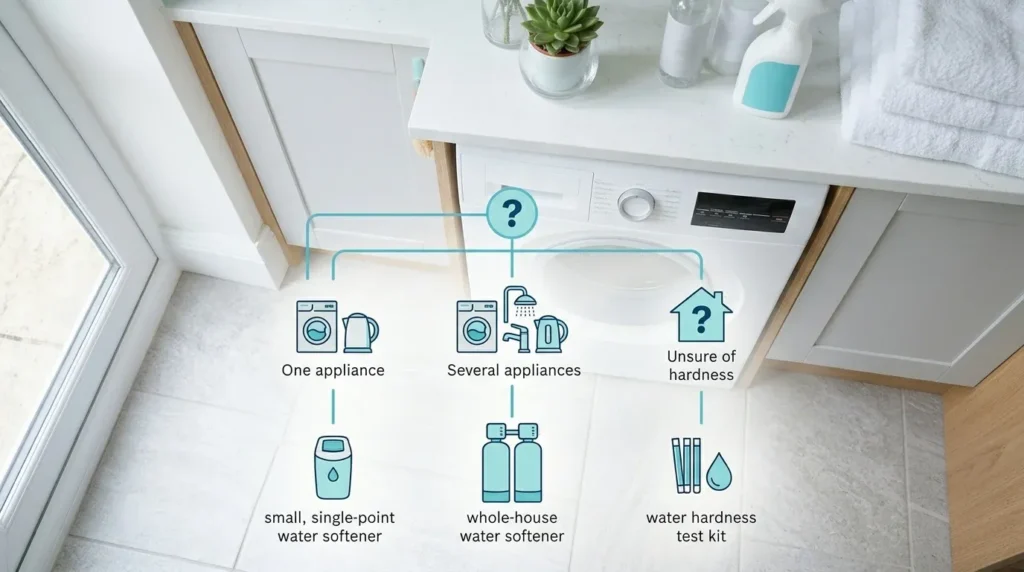
- One appliance is your concern: compare compatible laundry treatments and routine maintenance first.
- Several appliances are affected: investigate a domestic water softener.
- Unsure whether your water is hard: check your supplier’s information before buying anything.
Water Softener vs Limescale Prevention Product
| Question | Ion-exchange softener | Laundry anti-scale product |
| Reduces calcium and magnesium in treated water | Yes | Depends on formula; do not assume |
| Treats the household supply | Yes, for connected outlets | No |
| Used per wash | No | Usually |
| Covers multiple appliances | Yes, where connected | No |
| Needs plumbing installation | Usually | Usually not |
| Ongoing needs | Salt and maintenance | Product-dependent |
Some products control deposits without removing hardness minerals from the supply. The DWI also warns that some scale-control devices, including certain magnetic ones, do not actually soften water. Look at the stated treatment method and the evidence behind the claims, not just the word “softener” in the name.
Small and In-Line Water Softeners
Compact in-line devices look attractive, but size does not prove a device can soften water at your machine’s flow rate and your local hardness. Before buying, check:
- Treatment method: ion exchange or something else?
- Capacity: how much water it treats before servicing or regeneration.
- Flow rate: can it meet the appliance’s demand?
- Hardness range: is it designed for your supply?
- Connections: compatible with the machine and your plumbing?
- Maintenance: replacements, servicing or salt?
- Evidence: does the maker publish reliable performance data?
Be wary of products that claim to soften water but only describe magnetic, electronic or other scale-control effects. Scale reduction and genuine softening are not the same thing. If documentation is vague, ask the manufacturer first.
6 Common Mistakes to Avoid
- Not checking the treatment method. A “softener” may not remove calcium and magnesium.
- Ignoring your actual water hardness. Decide using local data.
- Changing detergent dose without checking instructions.
- Expecting a softener to repair damage. It cannot fix a pump, heating element, seal or electrical fault.
- Forgetting maintenance. Softeners need salt, servicing and correct settings, and the machine still needs routine cleaning.
- Overlooking drinking water. Plan an unsoftened drinking-water outlet with a qualified professional.
Myths vs Facts
| Myth | Fact |
| Every washing machine needs a softener. | Not necessarily. It depends on hardness, appliance requirements and your goals. |
| A laundry tablet equals a whole-house softener. | No. They serve different purposes. |
| Hard water is caused by dirt. | Hardness comes mainly from dissolved calcium and magnesium. |
| Every scale-control device softens water. | No. Some do not remove hardness minerals. |
| A softener repairs a damaged machine. | No. It addresses hardness, not mechanical or electrical faults. |
| Softened water means no detergent needed. | False. Detergent is still essential; follow its dosing instructions. |
| A softener removes all maintenance. | No. Cleaning and care remain important. |
| The priciest option is always best. | The best choice fits your needs, installation and running costs. |
Expert Tips for UK Homeowners
- Start with water hardness, not advertising.
- Separate prevention from cleaning. A descaler removes deposits when used as directed; a softener reduces hardness in the supply; an anti-scale product has its own function.
- Think beyond the washing machine. If kettle, shower, taps and dishwasher are affected too, compare whole-house cost against several separate treatments.
- Plan the drinking-water arrangement before installation, not afterwards.
- Keep a simple routine for both machine and softener.
- Demand evidence. Be sceptical of promises to fix all scale, add an exact number of years to appliance life, or save a set amount of money.
Frequently Asked Questions
Does hard water damage washing machines?
Hard water may cause limescale on parts that contact water and heat. The effect depends on your local hardness, your machine and how often you wash. Other issues can also cause faults.
Does a water softener help a washing machine?
Yes. A properly functioning ion-exchange softener reduces calcium and magnesium in treated water, helping reduce limescale-forming conditions.
What is the best water softener for a washing machine?
It depends on your needs. If several appliances suffer from hard water, a whole-house ion-exchange softener is likely a good fit. If only the washing machine is affected, a compatible anti-scale laundry product may be better.
Can you use softened water in a washing machine?
Generally yes, provided the machine and treatment system are compatible and installed according to their instructions.
Does soft water make clothes cleaner?
It can improve how detergents work in some situations, but results depend on detergent type, load size, soiling and wash settings.
Does soft water reduce detergent use?
It can change the amount needed, but follow the detergent maker’s dosage guidance for your water and load.
How do I reduce limescale in a washing machine?
Check your water hardness, choose an appropriate treatment if needed, clean the machine regularly and descale per the manufacturer’s instructions.
Are washing-machine water-softening tablets worth it?
They can suit people who want a targeted option without plumbing work. Check the ingredients, intended use, cost per wash and directions first.
Do washing-machine tablets replace a water softener?
No. Tablets are for individual wash cycles; a domestic softener treats the water supply to connected outlets.
Should I install a whole-house softener just for my washing machine?
Not automatically. Compare installation and running costs with a suitable laundry treatment. A whole-house system makes more sense if hard water affects several appliances.
Is an in-line water softener suitable for a washing machine?
It depends on its treatment method, capacity, flow rate and compatibility. Do not assume every in-line scale-control device reduces hardness.
How can I find out if my UK water is hard?
Check your water supplier’s published water-quality data or contact them for a hardness reading. The DWI notes that hardness varies by location.
Final Verdict: Is a Water Softener Worth It for a Washing Machine?
In a hard-water area, a water softener can be well worth it, especially when limescale affects several parts of your home. But a full system is not automatically right for every washing machine.
If one appliance is your concern, check your water hardness, read the machine’s manual and compare suitable laundry treatments. If you want to manage hardness across several connected appliances, consider a domestic ion-exchange softener.
Ask yourself three questions:
- How hard is the water supplied to my home?
- Is the washing machine my only concern, or are other appliances affected?
- Have I compared the total cost, maintenance and installation of each option?
AquaClariX takeaway: The smartest solution is not the most expensive one. Understand what your water contains, check what each product actually treats, and choose an approach that fits your home, budget and appliance.
Next Steps
- Find your local water hardness and read your washing machine’s manual.
- Compare a targeted laundry treatment with a domestic softener, counting both upfront and ongoing costs.
- Considering a whole-house system? Read our guides to how water softeners work, water softener maintenance and water softener salt.
- Wondering about household use? Read our guide to drinking softened water.
Sources:
1:https://www.amazon.co.uk/s?k=Calgon+4+in+1+washing+machine+tablets&utm_source
2:https://www.amazon.co.uk/s?k=Ecozone+laundry+water+softener+tablets&utm_source
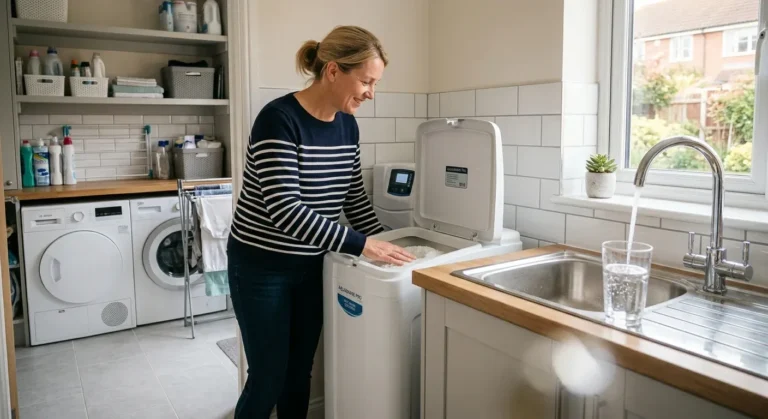
Water softener maintenance includes regularly checking salt levels, topping up the salt when needed, cleaning the brine tank, checking for salt bridges, inspecting for leaks, and monitoring the system’s regeneration cycle. Regular maintenance helps your water softener work efficiently, prevent common problems, and extend its lifespan. Always follow the manufacturer’s maintenance instructions for your specific model.
Water softener maintenance includes checking and topping up salt levels, cleaning the brine tank, checking for salt bridges, inspecting for leaks, and making sure the regeneration cycle is working properly. Regular maintenance helps your system run efficiently, prevent common issues, and last longer. Always follow your manufacturer’s maintenance instructions.
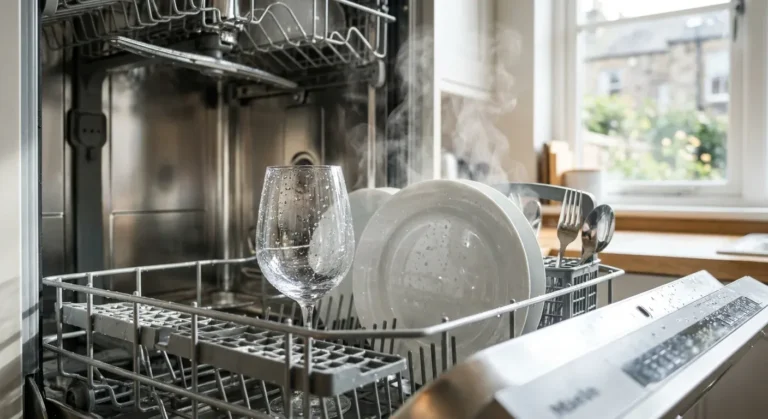
A dishwasher water softener is a built-in system that reduces water hardness by removing minerals such as calcium and magnesium. It helps prevent limescale deposits on dishes, glassware and the dishwasher’s internal components. Many dishwashers use special dishwasher salt to regenerate the softening resin and maintain effective performance. This helps improve cleaning results and protect your appliance from limescale build-up.
A dishwasher water softener is a built-in system that removes hardness minerals, mainly calcium and magnesium, from the water. It helps prevent limescale build-up, reduce cloudy marks on glassware, and protect your dishwasher’s internal components. Most dishwashers with this feature use special dishwasher salt to keep the softening system working effectively.
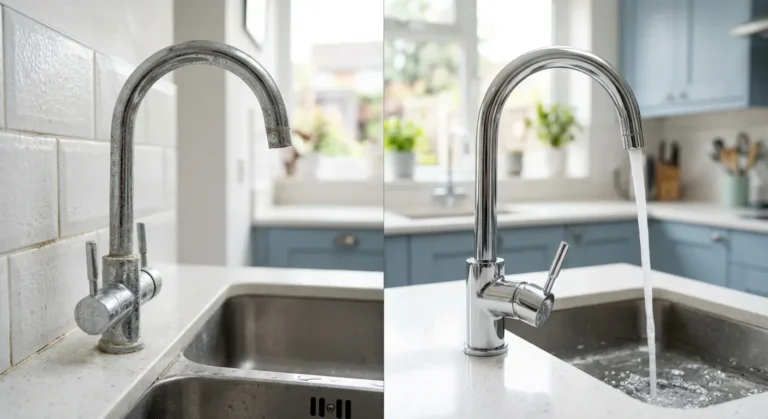
Yes, hard water can affect your shower by leaving limescale deposits on showerheads, taps and glass screens. It can also reduce water flow by blocking showerhead openings and make soap and shampoo harder to rinse away. Regular cleaning can help prevent build-up, while a suitable water softener can help reduce future limescale deposits.
Yes, hard water can affect your shower by causing limescale build-up on showerheads, taps and glass screens. It may also clog showerhead openings, reduce water flow and leave soap residue on your skin and hair. Regular cleaning and a suitable water softener can help reduce limescale and keep your shower in better condition.