Banish Stubborn Limescale: 7 Dishwasher Water Softener Solutions
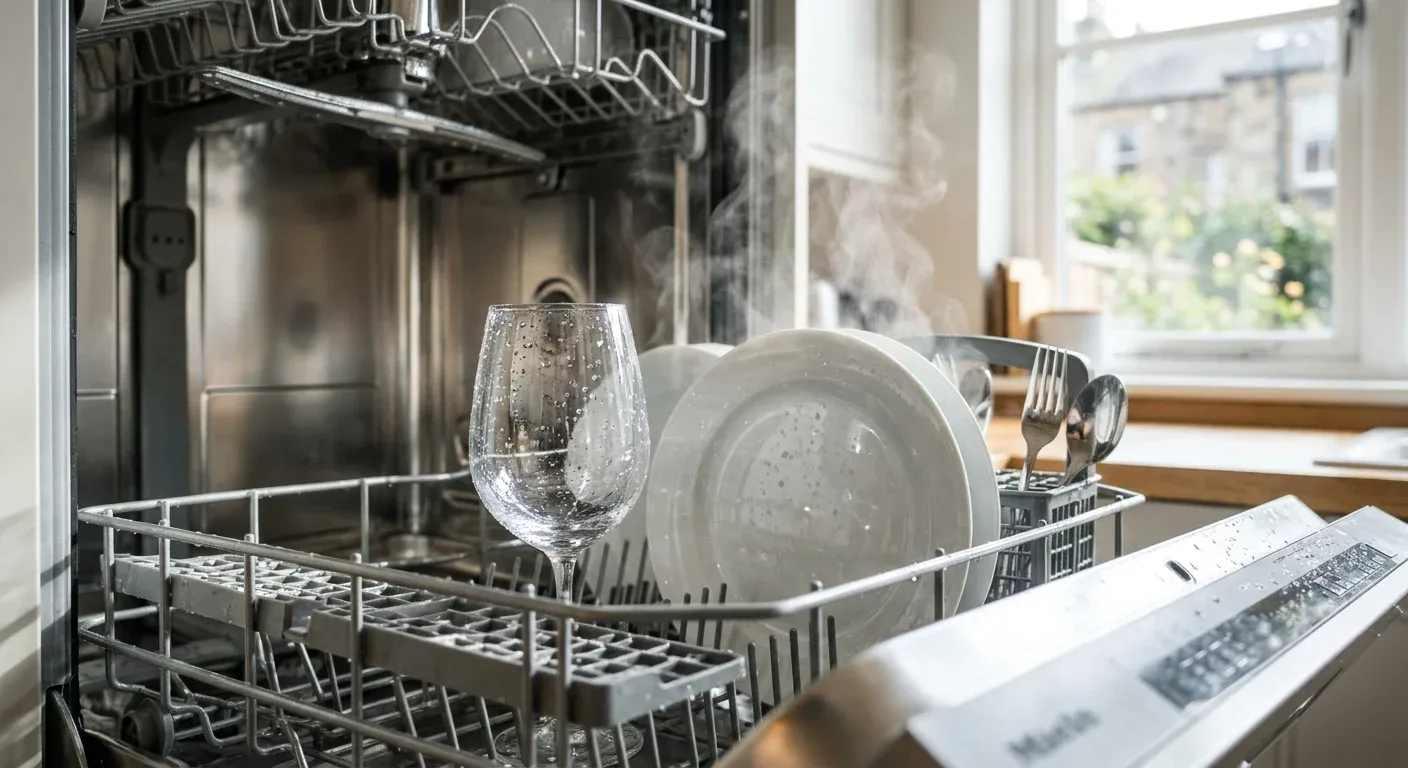
White spots on your glasses? Cloudy plates? A chalky film inside the dishwasher? Hard water is the usual suspect. But before you spend money on another water-treatment product, check one thing first: your dishwasher may already have a water softener built in.
Quick answer: Most modern dishwashers include an internal ion-exchange softener. To stop limescale, set the water-hardness level to match your local supply, use dishwasher salt if your model needs it, add rinse aid, and descale any existing buildup. A whole-house softener only makes sense when limescale affects several appliances.
This guide gives you seven practical solutions in the right order, explains how dishwasher salt differs from water softener salt, and shows when an external system is worth the money.
Key Takeaways
- You don’t always need a separate dishwasher water softener. Many models have one built in.
- Hard water contains dissolved calcium and magnesium, which cause limescale and white deposits.
- Setting the correct water-hardness level is the most important first step.
- Dishwasher salt regenerates the built-in softener. Rinse aid does not soften water.
- A whole-house softener treats every connected appliance, but you should still follow your dishwasher’s manual.
- Water hardness varies across the UK, so check your own supply rather than guessing.
Table of Contents
What Is a Dishwasher Water Softener?
A dishwasher water softener is a system that reduces water hardness before or during the wash cycle. It limits mineral deposits and helps the appliance clean the way it was designed to.
The term covers two different things.
1. A built-in dishwasher softener
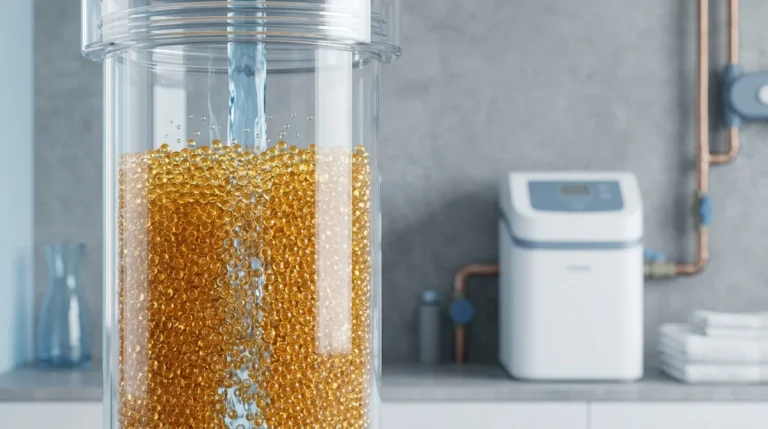
Many dishwashers contain an internal ion-exchange system. A resin captures calcium and magnesium ions from the water and swaps them for sodium ions. Special dishwasher salt then regenerates the resin so it keeps working. Exact design and requirements vary by model.
2. A whole-house water softener
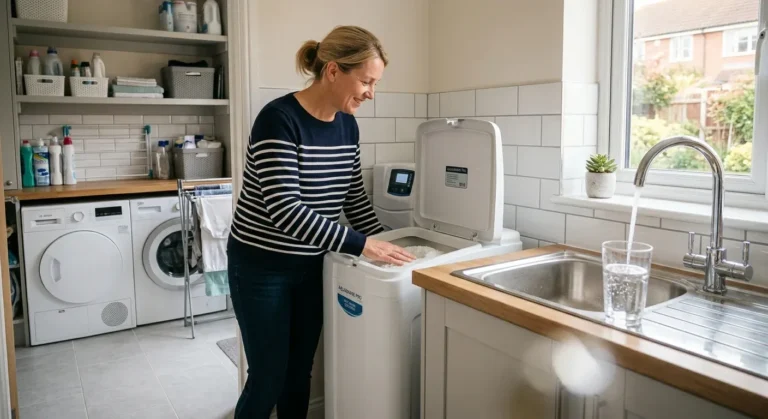
This unit is installed in the home’s plumbing and treats water for connected outlets and appliances, which can include the dishwasher, washing machine and shower.
Built-in vs whole-house softener
| Feature | Built-in dishwasher softener | Whole-house water softener |
| Location | Inside the dishwasher | Connected to household plumbing |
| Main purpose | Manage hardness for dishwasher use | Reduce hardness across the home |
| Salt | Dishwasher salt, when required | Salt suited to the external unit |
| Treats washing machine water | No | Yes, if connected |
| Treats shower water | No | Yes, if connected |
| Installation | Included with the appliance | Usually needs a plumber |
| Best for | Dishwasher-specific control | Whole-home limescale |
These systems work at different levels. Even with a whole-house softener, follow your dishwasher manufacturer’s instructions.
Why Does Hard Water Cause Dishwasher Limescale?
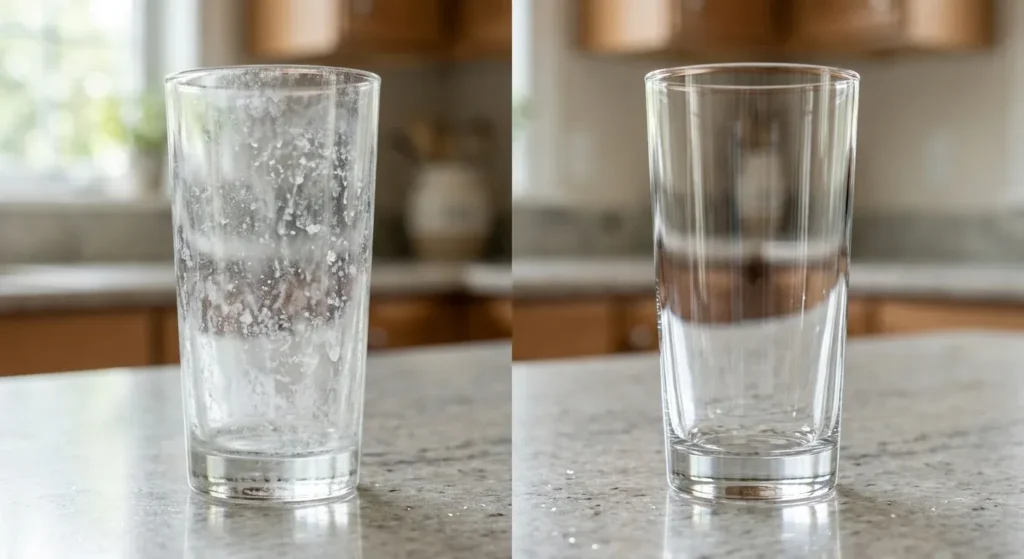
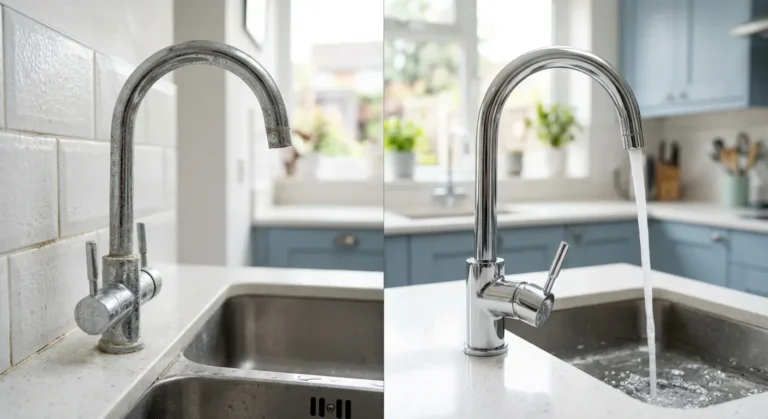
Hard water carries dissolved calcium and magnesium. When water evaporates from a glass, the minerals stay behind as white spots or a cloudy film. Inside the dishwasher, repeated heating makes deposits build up on surfaces that touch the water.
Common signs of hard water in a dishwasher:
- White spots on glasses and dishes
- Cloudy glassware
- Chalky buildup inside the machine
- Scale around parts exposed to hot water
- Residue that returns after every wash
Not every white mark is limescale. Detergent residue, too much detergent, poor rinsing and glass corrosion can look similar. A softener will not fix those.
For background on how calcium and magnesium relate to hard water, see the UK Drinking Water Inspectorate’s guidance on water hardness.
7 Dishwasher Water Softener Solutions
Work through these in order. They go from free checks to bigger investments.
1. Check Your Dishwasher’s Built-In Softener
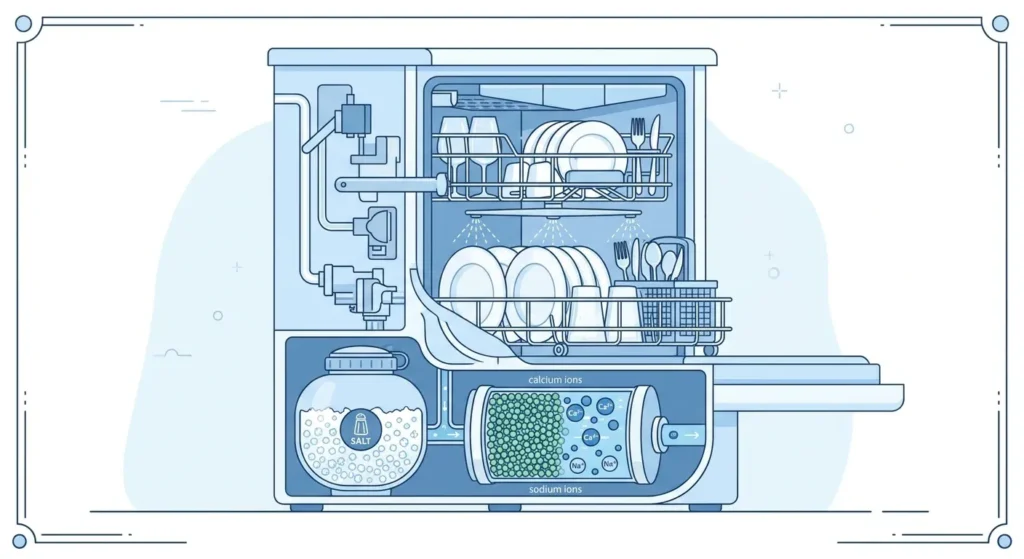
Best for: Households with limescale that may come from the wrong settings.
Before you buy anything, look in the manual or model specification for these terms:
- Water softener
- Water-hardness setting
- Dishwasher salt or salt reservoir
- Regeneration
If you find them, your machine already has the hardware to handle hard water. It just needs configuring. Brands such as Bosch and AEG publish model-specific guidance, and the Bosch UK water-hardness setting guide is a good example.
Action: Find your model number, confirm it has a softener, and follow the manual.
2. Set the Correct Water-Hardness Level
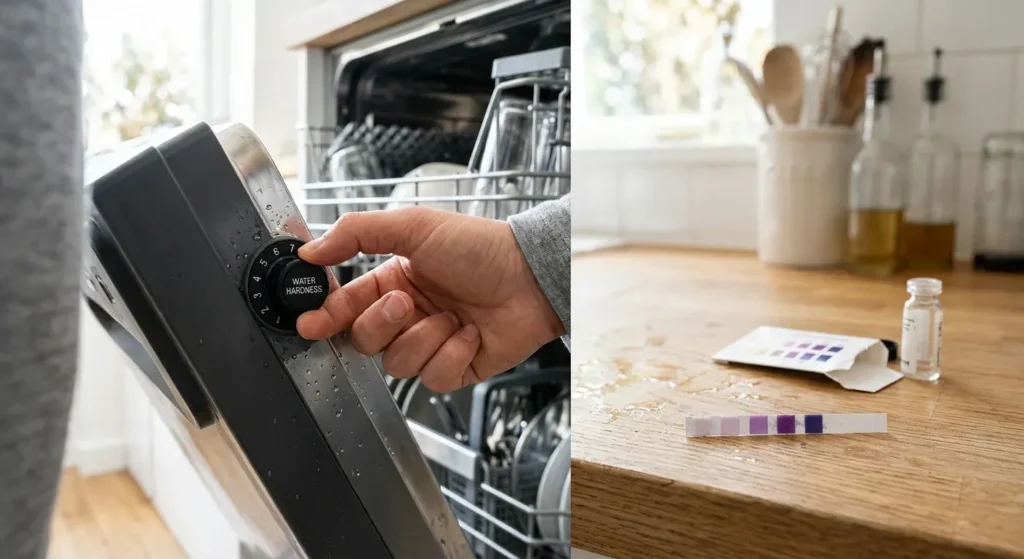
Best for: Dishwashers with a built-in softener that still leave cloudy glasses.
The softener must match the hardness of your incoming water.
- Find your hardness. Check your water supplier’s website, call customer service, or use a water-hardness test strip.
- Compare it with your manual’s scale. Brands use different units: German degrees (°dH), French degrees (°fH) or millimoles per litre. A setting number on one brand does not equal the same number on another.
- Choose the matching setting.
Avoid this mistake: Choosing the highest setting just because you live in a hard-water area. Match it to your actual hardness.
3. Use the Correct Dishwasher Salt
Best for: Dishwashers with a salt-based softening system.
Dishwasher salt regenerates the resin so it keeps removing calcium and magnesium. Without it, a salt-based softener loses performance. Requirements depend on your model, your water hardness and the manufacturer’s instructions.
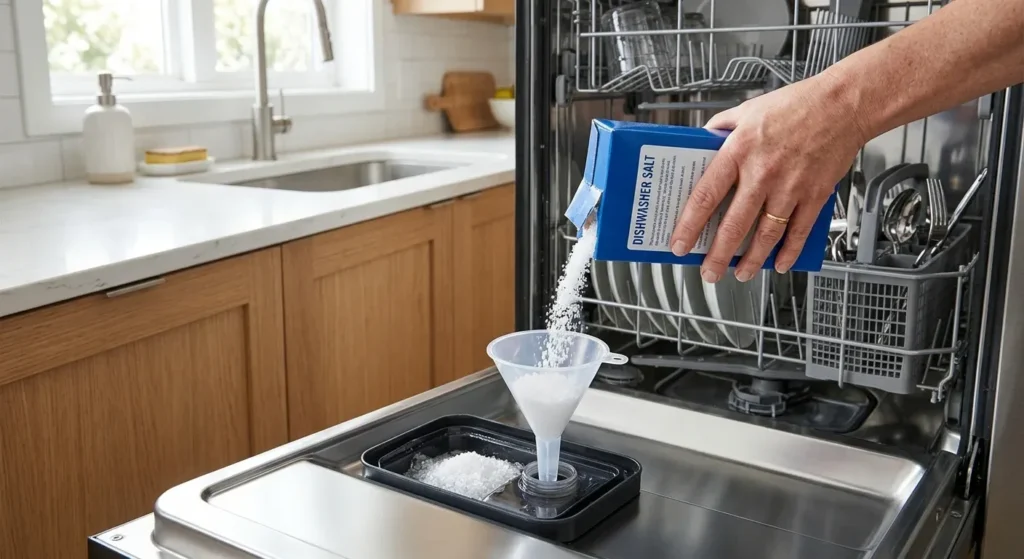
How to refill the salt reservoir:
- Check the salt indicator and the manual.
- Confirm the hardness setting.
- Use salt made for dishwashers.
- Follow the filling instructions.
- Wipe up spilled salt and run a cycle afterwards if the manual says so.
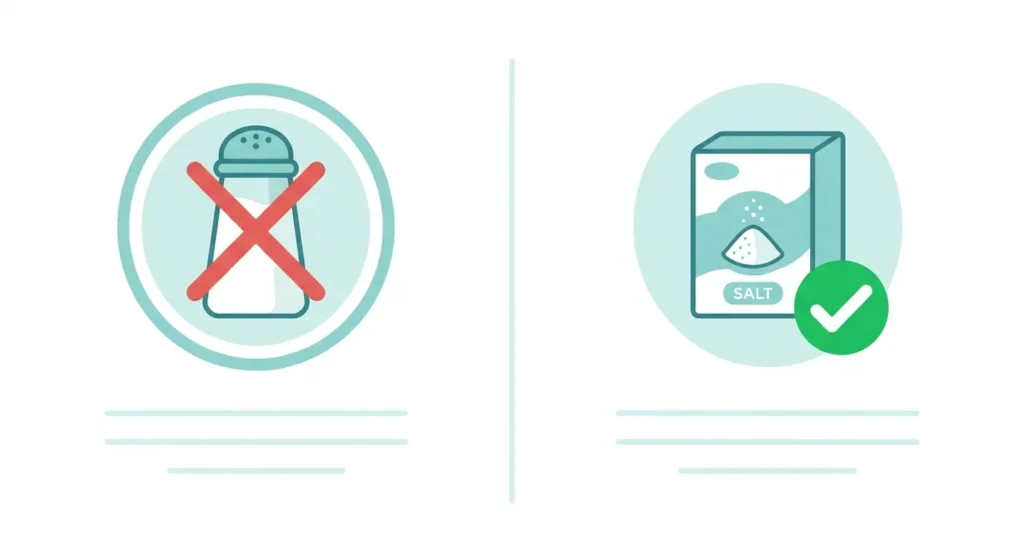
Never put salt in the detergent dispenser. Never use table salt, sea salt or unrelated water-treatment products, because the grain size and composition can harm the system. Bosch explains more in “What does dishwasher salt do?”.
4. Use Rinse Aid and the Right Detergent
Best for: Water spots and poor drying that limescale alone doesn’t explain.
Each product has a different job:
| Product | What it does |
| Water softener | Reduces calcium and magnesium |
| Dishwasher salt | Regenerates the built-in softener |
| Rinse aid | Helps water run off for better drying and fewer marks |
| Detergent | Removes food, grease and soil |
To get the best results:
- Refill rinse aid when your machine prompts you.
- Use a detergent suited to your dishwasher and water.
- Stick to the recommended dose. More is not better.
- Check whether your tablets cover local water hardness.
All-in-one tablets may contain softening components, but in hard water your dishwasher may still need salt. Always check your manual.
If dishes still look dirty, inspect your loading, spray arms, filter and wash programme.
5. Remove Existing Limescale and Clean the Machine
Best for: Dishwashers with visible deposits.
Softening is preventive. It reduces hardness in the water but doesn’t remove scale that has already formed. Use a dishwasher cleaner or descaler approved for your model, and follow the instructions. Never mix cleaning products.
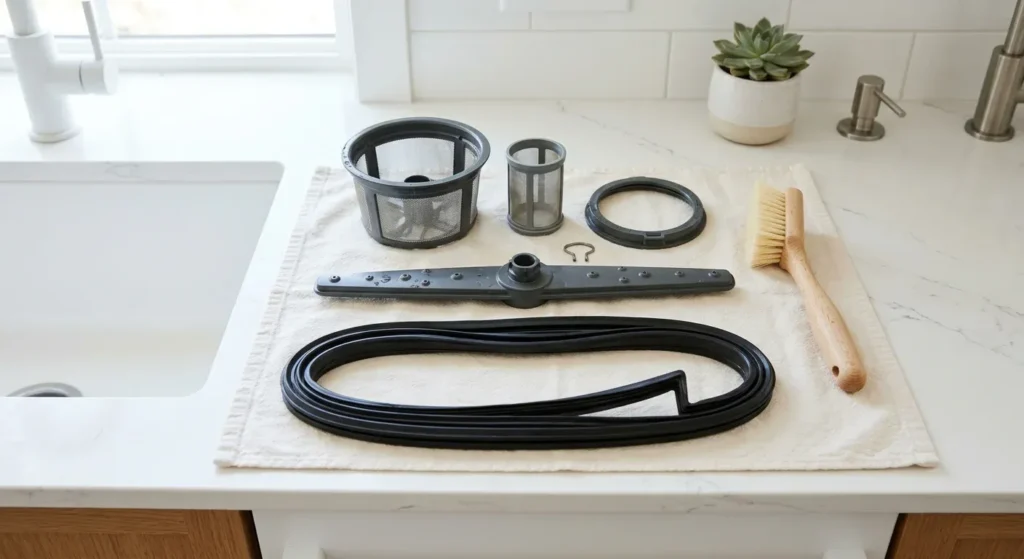
Also check these areas:
- Filter: food debris restricts flow.
- Spray arms: blocked holes weaken cleaning.
- Door seals: residue collects here.
- Detergent compartment: buildup can interfere with dispensing.
Don’t dismantle internal parts unless the manufacturer lists the task as user maintenance. If scale keeps coming back, look at the underlying water hardness too.
6. Consider a Whole-House Water Softener
Best for: Homes where limescale affects several appliances and fixtures.
If your dishwasher, kettle, shower, taps and washing machine all show scale, fixing each one separately isn’t practical. A whole-house softener reduces hardness across the connected supply.
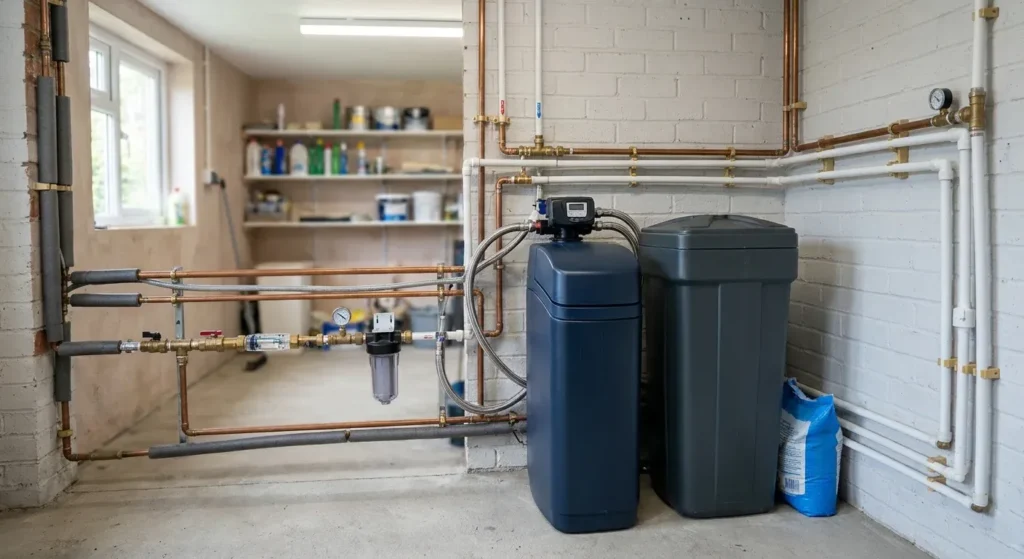
Potential benefits:
- Less scale in connected appliances
- Less mineral buildup on water-contact surfaces
- Easier cleaning of scale-prone areas
- One system instead of several treatments
Costs to weigh up: purchase price, installation, salt, maintenance, space and running requirements.
Important UK note: Conventional ion-exchange softeners swap calcium and magnesium for sodium. The Drinking Water Inspectorate’s guidance on domestic softeners explains why households should keep an unsoftened supply for drinking and cooking, usually the kitchen cold tap.
Rule of thumb: Choose whole-house treatment when the problem goes beyond the dishwasher, not because of one cloudy glass.
7. Reassess Your Dishwasher Settings if You Already Have a Softener
Best for: Homes with a whole-house softener that still have salt or limescale issues in the dishwasher.
A household softener changes the water your dishwasher receives, which affects how its built-in softener should be set. Don’t leave everything unchanged, but don’t switch off the softener or stop adding salt without checking either.
- Confirm the dishwasher is on the softened supply.
- Find the hardness of the water entering the machine after treatment.
- Read the manufacturer’s guidance for externally softened water.
- Adjust the internal setting only as instructed.
- Follow the salt requirements for that setup.
No single setting suits every Bosch, Miele, AEG or Whirlpool model. If you’re unsure, contact the manufacturer or a qualified engineer.
Dishwasher Salt vs Water Softener Salt
| Feature | Dishwasher salt | Whole-house softener salt |
| Intended system | Dishwasher’s built-in softener | Domestic softening unit |
| Where it goes | Dishwasher salt reservoir | External unit’s brine tank |
| Purpose | Regenerates the internal resin | Regenerates the external resin |
| Specification set by | Dishwasher manufacturer | Softener manufacturer |
Don’t put softener salt in your dishwasher unless the manufacturer confirms it is suitable. Likewise, don’t assume dishwasher salt suits an external softener.
Remember: Dishwasher salt is not detergent, and rinse aid is not a water softener.
Can a Whole-House Water Softener Protect Your Dishwasher?
Yes. If your dishwasher receives water from a suitable whole-house softener, less calcium and magnesium reaches the appliance, which helps limit new scale.
The benefit depends on your original hardness, how well the unit works and your dishwasher’s design. It won’t solve detergent residue, blocked spray arms or poor loading. Keep the UK guidance on retaining an unsoftened drinking supply in mind when planning the plumbing.
8 Common Dishwasher Water Softener Mistakes
- Buying an external softener before checking the dishwasher. Many models already have one.
- Guessing the hardness setting. Scales differ between brands. Use your supplier’s data and the manual.
- Using ordinary salt. Table salt can interfere with or damage the softening system.
- Assuming rinse aid softens water. It helps drying and spotting, not hardness.
- Expecting softened water to fix everything. Dirty filters, blocked arms and poor loading still matter.
- Stopping salt without checking. If you have a whole-house softener, follow your dishwasher manufacturer’s guidance.
- Ignoring existing scale. A softener prevents new buildup but won’t remove old deposits. Descale separately.
- Assuming every UK home has hard water. Hardness varies widely. Check your own supply.
Dishwasher Water Softener Maintenance Checklist
| Task | What to check |
| Water hardness | Get current data from your supplier or use a test |
| Softener setting | Match incoming water to the manual |
| Dishwasher salt | Refill when required |
| Salt cap | Make sure it is closed properly |
| Rinse aid | Refill per the manual |
| Filter | Clean as recommended |
| Spray arms | Check for blockages |
| Interior | Look for deposits and residue |
| Detergent | Right product, right dose |
| Whole-house softener | Follow its own service schedule |
Maintenance still matters with softened water. A dishwasher needs good detergent, free water circulation and the right programme.
Myths vs Facts
| Myth | Fact |
| Every dishwasher needs a separate softener. | Check for a built-in one first. |
| Table salt and dishwasher salt are the same. | Manufacturers specify salt made for their systems. |
| Rinse aid removes water hardness. | It helps drying and reduces some spotting, not mineral hardness. |
| A whole-house softener makes dishwasher settings irrelevant. | You still need to follow the manufacturer’s instructions. |
| Every white mark is limescale. | Detergent residue and glass corrosion look similar. |
| Softened water guarantees spotless dishes. | Detergent, loading and maintenance matter too. |
Is a Dishwasher Water Softener Worth It?
For most UK households, using the built-in softener correctly is the best place to start. Whether a whole-house unit pays off depends on the wider problem.
| Your situation | Sensible first step |
| Only the dishwasher shows scale | Check the built-in softener and settings |
| White marks on dishes | Check hardness, salt, rinse aid and detergent |
| Several appliances have limescale | Investigate household water hardness |
| You already have a whole-house softener | Read your dishwasher’s guidance for softened water |
| You’re unsure your water is hard | Ask your water supplier |
| Cleaning is poor despite correct settings | Inspect filter, spray arms, loading and maintenance |
Frequently Asked Questions
Do dishwashers need a water softener?
Many already include one. Check your manual, then set it to match your local water hardness.
Does a water softener help a dishwasher?
Yes. Less calcium and magnesium means less hard-water scale. It won’t fix every cleaning problem.
Can you use softened water in a dishwasher?
Yes, if the installation is suitable. Follow the manufacturer’s instructions on hardness settings and salt.
Do I need dishwasher salt if I have a whole-house softener?
Not necessarily. It depends on the hardness of the water reaching the dishwasher and on the manufacturer’s guidance. Check before changing anything.
Is dishwasher salt the same as water softener salt?
No. They suit different equipment. Use only products approved for your system.
How do I prevent limescale in a dishwasher?
Find your water hardness, set the built-in softener correctly, use dishwasher salt if required, and maintain the machine as the manual describes.
Does hard water damage dishwashers?
It can cause scale, including around parts exposed to hot water. That doesn’t mean the dishwasher will fail.
Can a whole-house softener supply a dishwasher?
Yes, if the plumbing is set up to deliver treated water. Still check the dishwasher’s settings and salt needs.
Should I install an external softener just for my dishwasher?
Usually no. Investigate the built-in softener first. An external system suits homes where several appliances are affected.
How do I know if my dishwasher has a built-in softener?
Search the manual or specifications for “water softener”, “water-hardness setting”, “regeneration” or “dishwasher salt”.
Why are my glasses still cloudy after adding dishwasher salt?
Common causes are a wrong hardness setting, too much or too little detergent, empty rinse aid, poor rinsing or glass corrosion. Check your manual before adding more salt.
Can I use dishwasher tablets instead of salt?
It depends on the tablet, your water hardness and your dishwasher. Some tablets contain softening agents, but they don’t always replace the salt your system needs. Check your manual.
Final Verdict
The right dishwasher water softener solution depends on your machine and your water. For most homes, follow this order:
- Find your local water hardness.
- Check whether your dishwasher has a built-in softener.
- Set the hardness level using the manual.
- Use dishwasher salt if your model requires it.
- Check your detergent and rinse aid.
- Descale existing deposits and maintain the machine.
- Consider a whole-house softener if limescale affects several parts of your home.
Don’t buy extra equipment just because you spotted a white mark. Find the cause first, then choose the fix that matches it. And if you install a whole-house softener, keep an unsoftened supply for drinking and cooking, as the Drinking Water Inspectorate advises.
Have you battled limescale or cloudy glasses? Leave a comment and tell us what worked for you.
Sources:
1:https://www.amazon.co.uk/s?k=Finish+dishwasher+salt&utm_source
2:https://www.amazon.co.uk/s?k=water+hardness+test+strips&utm_source